Saturday, 29 May 2021

What is happening with "digitalization" in Education?

I am currently involved in a large-scale project on digitalization. The aim of the project is to instil practices relating to the manipulation of data, coding, algorithmic thinking and creativity throughout the curriculum in the University. While this appears, on the one hand, an attempt to reignite the "everyone should code" kind of stuff, something is clearly happening with the technology which is necessitating a reconfiguration of the activities of education with the activities of society. 

As with many big structural changes to education, there are already quite a few signs of changes in practice in the University: many courses in the humanities and sciences are using programming techniques, often in R and Python. My university has established faculty-based "data centres" - rather like centres for supporting e-learning - which provide services in analysis and visualisation. However, across the sector, there is as yet little coherence in approaches. It is rather like the situation with teachers using the web in the late 90s where enthusiastic and forward-thinking teachers would put their content on websites or serve them from institutional machines. The arrival of VLEs codified these practices and coordinated expectations of staff, students and managers. This is what is likely to happen again, but instead of codifying the means of disseminating content, it will codify programming practices across different aspects of the curriculum.  

There is a further implication of this, however, which has to do with the nature of disciplines and their separation from one another. One of the reasons why digitalization has such a hold in education at the moment is the dominance of digitalization in industry across all sectors. Where sectors might have distinguished themselves according to expectations formed around concepts, products and markets, increasingly we are seeing coordination of industrial activities around practices and processes. This has been slowly happening for the last 20 years or so, but is evidenced by the way that industries are realigning themselves by synergising practices and technologies across different fields of activity. Think of Amazon. This has been coupled with increasing "institutional isomorphism" in the management of institutions across the board. This has produced many problems in institutional organisation - partly because the old identities of institutions have been torn-up and new identities imposed which, although they exploit the new technologies available, almost always reinforce and amplify the hierarchies and inequalities of the old institution.  

With this in mind, this next phase of digitalization is going to be very interesting. The old hierarchies of the university are established around academic departments and subjects. These are basically codified around concepts which, within academia, operate to define and redefine themselves in contradistinction to one another. This is not to say that interdisciplinarity isn't something that's emerged: obviously we have things like biochemistry or quantum computing, but even within these new fields which appear interdisciplinary, the codification around concepts is the central mechanism which provides coherence. Look, for example, at how academic communities fracture and form tribes: not just the mutual antipathy between psychology and sociology, but between "code biology" and "biosemiotics", heterodox vs classical economics, etc. A lot of this kind of division has to do not just with disciplinary identity, but personal identity. Concepts are tools for amplifying the ego (am I not doing it here?), and the principal mechanism for this process has been the way we conduct scientific communication. 

Digitalization means that increasingly we are going to see research and learning coordinated around practices with tools. This is a more fundamental change to what is loosely called the "knowledge economy". It won't be enough to simply name a concept. We will need to show how what is represented by a concept actually works. Argument will be increasingly embellished with concrete examples, some in code, and all of which presented in a way in which mechanisms can be communicated, experimented with, new data applied to, refined, and continually tested. More importantly, because these practices become common, and because practices supersede concepts in scientific inquiry, the traditional distinctions between disciplines will be harder to defend. This will produce organisational difficulties for traditional institutions in which disciplines will perceive threats in the digitalization process and seek to defend themselves.

Another threat may come in the form of what might be called the "status machine" of the university. Concepts don't only codify a discipline, they codify the status of those who rise to positions where they can declare concepts (what Searle, who is not alone in pointing out this mechanism, calls "deontic power").  While new practices are codified in a similar way, practices are only powerful if they are adopted widely, and in being adopted, they are continually adjusted. Eventually we don't care about the concept or who thought of it, but about being part of the game which is developing and upholding a common set of practices. The operating system Linux is a good example: nobody really cares about who invented it; but we do care about using and developing it. We can start to make a list of similar practices which fit this model: computer languages, online programming environments, visualisation tools, etc.

But the university is a "status machine": its business ultimately lies in selling certificates and through codifying status. So if it comes to be about practice rather than status, what does the University then do? New forms of personal status codification are emerging. The online machine learning competition site Kaggle, for example, provides opportunities to do real and meaningful data analytic activities. Winning a Kaggle competition is an important marker of personal status carrying more meaning than a degree certificate because it demonstrates what someone can actually do, with references to things that were actually done. But Kaggle does not lock its status mechanisms behind the expensive close-system of an institution: it is open and free, funded by the fact that the fruits of intellectual labour become the property of Kaggle (and by extension, Google). Intellectual activity given to the platform is exchanged for status enhancement. It is in many ways an extension of the Web2.0 business model with some important differences. 

What happens in Kaggle educationally is particularly interesting. Kaggle teaches simply by providing a network of people all engaging in the same activities and addressing the same, or related, problems. There is no curriculum. There are emerging areas of special interest, techniques, etc. But nothing codified by a committee. And it exists in the ecosystem of the web which includes not only what Kaggle does, but what StackOverflow does, or anything else that can be found on Google. Human activity contributes to this knowledge base, which in turn develops practices and techniques. Learners are effectively enlisted as apprentices in this process. Experts, meanwhile, will go on to exploit their knowledge in new startups, or other industrial projects, often continually engaging with Kaggle as a way of keeping themselves up-to-date.

The University Professor, meanwhile, has both become increasingly managerial, and increasingly status-hungry as they seek the deontic power to declare concepts, or make managerial things happen ("we should restructure our University" is a common professorial refrain!), but increasingly (and partly because there are so many of the bastards now), nobody is really interested - apart from those who will lose their jobs as a result of professor x. We just end up with a lot of mini-Trumps. Deontic power doesn't work if nobody believes you, and it doesn't do any good if, even if they listen to you, they merely repeat the conceptualisations you claim (but with different understandings). The academic publishing game has become very much about saying more and more about less and less, where each professorial utterance merely adds to a confusing noise that only benefits publishers.

Kaggle shows us that we don't need professors. There will always be "elders" or "experts" who have more skin in the game and know how to use the tools well, or to apply deeper thinking. But it is not about leading through trying to coin some attractive neologism.  It is about leading through practice and example. 

Here we come to the root of the organisational challenge in the modern university. Their layers of management are not full of people leading by example with deep skill in the use of digital tools. They are full of people who postured with concepts. And yet, these are the people who have to change as the next wave of digitalization sweeps over us. I suspect it's not going to be an easy ride.

Thursday, 6 May 2021

Technology, Conversation and Maturana

I wrote this last month for the Post-Pandemic University blog (see Technology and Conversation – The post-pandemic university (postpandemicuniversity.net)). Maturana was on my mind. I saw him speak at the American Society for Cybernetics conference in Asilomar, CA in 2012. There were many other cybernetics luminaries there for the Bateson celebration "An Ecology of Ideas" (see Microsoft Word - all.docx (asc-cybernetics.org))  I also remembered from that event Jerry Brown's motorcade arriving (he was a Bateson student), Nora Bateson's film, Graham Barnes's talk ("How loving is your world?"... Graham also died recently), Terry Deacon's talk and Klaus Krippendorff's birthday celebration. It was quite an event.  

I don't remember an awful lot of Maturana's talk except for a remark he made about learning in response to a question: "What we learn, we learn about each other". 

That deserves a huge YES!

So here's my postpandemic piece. And that comment from Maturana about learning runs all the way through it.

.....

Biologist Humberto Maturana once wrote a poem called “The Student’s Prayer” in response to the unhappiness of his son in school. It goes:

Don't impose on me what you know,
I want to explore the unknown
And be the source of my own discoveries.
Let the known be my liberation, not my slavery.
The world of your truth can be my limitation;
Your wisdom my negation.
Don't instruct me; let's walk together.
Let my richness begin where yours ends.
Show me so that I can stand
On your shoulders.
Reveal yourself so that I can be
Something different.
You believe that every human being
Can love and create.
I understand, then, your fear
When I asked you to live according to your wisdom.
You will not know who I am
By listening to yourself.
Don't instruct me; let me be
Your failure is that I be identical to you.

Maturana’s poem speaks of the importance of exploration and conversation in learning – what he calls “walking together”. Taken literally, conversation is actually “dancing together” because the Latin “con-versare” means “to turn together”. I find this a useful starting point for thinking through the confusing categories by which we distinguish online activities and artefacts from face-to-face engagements. Anyone who has danced with anyone else knows that it doesn’t work by one person imposing something on the other. It does require “leading”, but the leader of the dance engages in a kind of steering which takes into account the dynamics of the whole situation including themselves and their partner.

What happens in this steering process is also revealed in “conversation”: it is a negotiation of constraints – “this is how we can move”, “this is how I am able to move”, and so on. Like dancing, conversation is not about imposition. In a conversation, participants reveal their understanding and their uncertainty through the many utterances that they make. Those utterances are multiple attempts to describe something which lies beyond description. But taken together, something is revealed, and if it works, like the dancer and their partner, each person becomes a different version of the same thing – rather like a counter-melody to a familiar tune. A richer reality emerges through the counterpoint of multiple descriptions.  

This understanding of conversation is the antithesis of the increasingly transactional way in which the education system seems to view the “delivery” of education. This is not merely an exchange of words, essays, text messages, tweets, or blog posts. It is a coordination. Or perhaps more deeply (to borrow some terminology from Maturana) it is a “coordination of coordinations”.

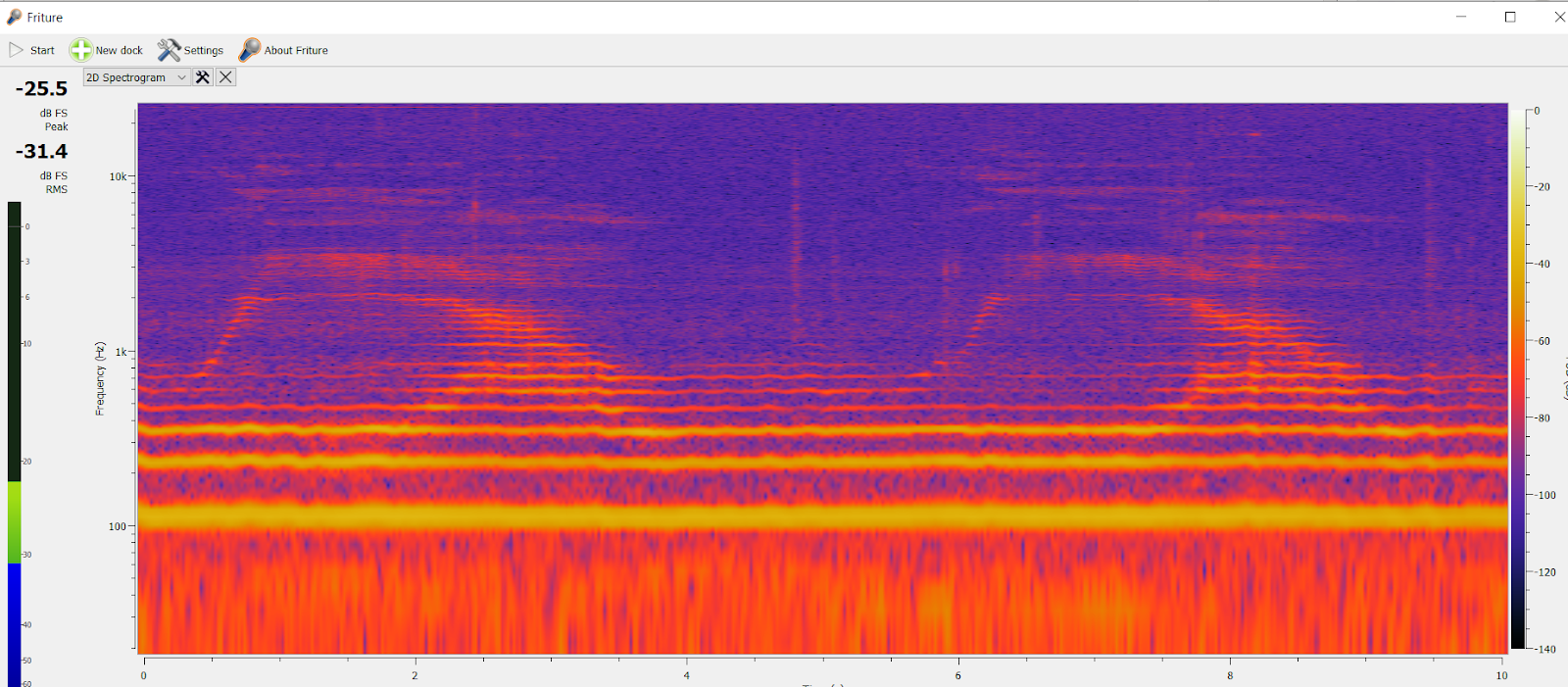
When I try to explain this, I sometimes use some software called “Friture” which graphs the spectrum of sound in real-time. You can download the software here (http://friture.org). I ask people to sing a single note (or at least try) and capture it on the computer. The resulting spectrum shows a set of parallel lines representing the many frequencies which combine in making the single sound. Conversation is like this, I say.

Indeed, we can explore things further with sound. If you sing the note while gradually changing the shape of your mouth to make the different vowel sounds, the number of lines decrease and increase. The narrow “e” sounds are rather like a tinny transistor radio. The fuller “ah” sounds are more “hi-fi” and rich. So the more simultaneous versions of the same thing, the more “real” it feels. Try it!

The message is that our grasp on reality and the effectiveness of our social coordination requires the coordination of diverse voices – and that is what conversation is about. The physicist David Bohm, who made the connection between a view of quantum mechanics and scientific dialogue, explained it more elegantly here: (1) David Bohm on perception – YouTube. And there is a political message: the richness in our understanding of reality entails the conditions of a free society which embraces diversity and creates the conditions for conversation: that is, one that doesn’t impose one particular description of the world on everyone else. That merely produces the tinniest of transistor radios!

Technically, in the world of information theory, multiple descriptions of the same thing are termed “redundancy”, which is another word for “pattern”. This is useful when we try to make sense of the relationship between the conversations that we have face-to-face, and the phenomena that we experience online. 

The Internet’s Multiplicity

The internet has vastly expanded the multiplicity of descriptions of the world. Does the internet dance in much the same way that our face-to-face conversation dances? I think it does, but to understand how it does, we have to look a bit more deeply at the kinds of multiplicity involved in all conversation. 

The internet produces its multiplicities differently. Face-to-face conversation is comprised of gestures, words, phonemes, and prosody – we wave our arms, use our eyes, change the pitch of our voice, and often repeat ourselves. The repetition we might think of as a “diachronic” (over time) redundancy; the arm-waving, voice pitch, gestural stuff is “synchronic” (simultaneous). Returning to the sound spectrum analyzer, the parallel lines identify the synchronic aspects, while if we were to sing a melody, the changing pattern over time represents the diachronic dimension. 

So what if the balance between synchronic redundancy and diachronic redundancy can be shifted around? What if parts of what is synchronic, become diachronic? Isn’t that what happens on the internet? 

Our snippets of text, video, emails, game plays, hyperlinks, blogs, timelines, likes, shares and status updates do not happen at the same time. While some of them (like video) contain rich synchronic aspects similar to face-to-face engagement, and text itself is a remarkably rich synchronic medium (without which poetry wouldn’t exist!), much of the multiplicity (or the redundancy) occurs diachronically as well as synchronically. The timeline matters; the concern for a particular individual’s understanding matters. And we may never meet somebody face-to-face, but following them on Twitter might mean that we get to know them as if we had, and perhaps a bit better.

Why don’t your Zoom lectures Dance?

So why, when it comes to education online, does so much seem deathly? Why doesn’t your zoom lecture dance? If the internet dances, why can’t education join in?

To answer this, we have to examine education’s constraints. And here we meet the very things that Maturana was railing against. Why is it so dreadful? Because the basic function of the system is to impose on students what is already known, examine them and certificate them. It instructs, reproduces and fails (at least, in Maturana’s terms): more goose-step than dance. 

There are of course reasons why this is so. After all, how would a meaningful assessment system operate if learners were allowed to be different from one another or do completely different kinds of activities? Well-intentioned though ideologies like “constructive alignment” are, inevitably they get used to hammer abstract “learning outcomes” into students in the same way that we hammer in facts. In short, online learning is crap not because of technology, but because of the constraints of the institution. But our institutions took their form in a world where our available tools were limited, meaning that this was the most effective way to organise education at the time. If we started from scratch today, with the tools that we now have, might our institutions would look and behave very differently?

We have a vestigial education system which increasingly insists on a transactional “delivery of learning” and its measurement. Shifting this ideology online brings the added disadvantage that the internet does not afford the same synchronic richness of face-to-face situations (which at least mitigate the pain of instruction), while the education system cannot adapt to the internet’s rich diachronic mode of operation.

Dancing on Stilts

But it was always obvious to the pioneers of technology in education that learning with technology was a different kind of dance. One would end up dancing on stilts or trying to play Mozart wearing mittens if one insisted on reproducing established ways of institutional education online. 

In a very revealing passage explaining his core idea of “teach back” (where a teacher would ask a learner to teach back what they had learnt), Gordon Pask noted something fundamental in the patterns of teaching and learning processes that chimes with Maturana’s poem:

“The crucial point is that the student’s explanation and the teacher’s explanation need not be, and usually are not, identical. The student invents an explanation of his own and justifies it by an explanation of how he arrived at it” (Pask 1975)

What Pask argued was that it was the redundancy of the interactions that mattered in the dance. 

Technology and Institutional Structure

Now we have amazing technology, this redundancy can come in many forms and many different kinds of media. Videos, blogs, social media interactions, and so on. And yet within the context of formal education, we rarely harness this diversity because it presents organisational problems in the assessment and management of the formal processes of education. The root cause of why we dance on stilts lies in the structures of education, not in any particular pedagogy or “ed-tech”. 

This is the paradox of the current state of the uses and abuses of technology in education. The need for technical innovation in education lies in the use of technology to reform the management and structures of education which constrain teachers and learners to such an extent that it makes online education unbearable. The actuality of “ed-tech” innovation in education lies in corporations feeding on the obvious inadequacies of online learning, looking for a chunk of the enormous sums of money going into education, and pitching for minor improvements to fundamentally broken processes, while often burdening institutions with increasingly complex technical infrastructure and expensive subscriptions. 

There is hope. The internet really does dance, and the students are getting increasingly good at using it (and indeed, some teachers!). Educational institutions are like a Soviet-style old-guard in a rock-and-roll world. Technology is the lubricant that will eventually free everything up – but the old guard will be slow to shift. 

We have to decide what our educational institutions are for. Are they there to “deliver learning” and make profits and pay vice-chancellors obscene salaries? Or are they there for creating the contexts for new conversations? It is a fork in the road. One way lies a future of ed-tech which feeds on the inadequacies of the existing system like a parasite. The other lies a future of technology being used to transform the self-steering both of institutions and individuals in their dances with each other and society.

Thursday, 29 April 2021

Real "Digital" vs Education's idea of "digital": Some reflections of computational thinking

Digitalization is (once again) the hot topic in education. Amid concern that students leave university without digital skill, educational policy is focusing on "instilling digital skill" from primary school upwards. In Europe and the US, this is labelled "computational thinking", and is closely related to the (rapidly failing) drive to push computer science in schools.

Rather like the STEM agenda, to which it is of course related, there is a difference between education's idea of "digital" and the real-world of "digital" which is happening in institutions and companies, for which skills are definitely needed. 

What is the real world of digital? Perhaps the first thing to say is that there is no single "real world". There are dispositions which are shared by technical people working in a variety of different environments. And there are vast differences between the kinds of environments and the levels of skill involved. For example, Python programming to analyse data is one thing, using tools like Tableau is another. There are the hard-core software development skills involved in enterprise system development with various frameworks (I'm currently banging my head against Eclipse, Liferay and Docker at the moment), and then there are those areas of skill which relate to the sexier things in technology which grab headlines and make policymakers worry that there is a skills gap - AI particularly.

So what do governments and policy makers really mean when they urge everyone towards "digitalization"? After all, engineering is pretty important in the world, but we don't insist on everyone learning engineering. So why computational thinking? 

Part of the answer lies in the simple fact of the number of areas of work where "digital" dominates. The thinking is that "digital skill" is like "reading" - a form of literacy. But is digital skill like reading and writing? Reading, after all, isn't merely a function which enables people to work. It is embedded in culture as a source of pleasure, conviviality, and conversation. By contrast "digital skill" is very pale and overtly functionalist in a way that reading and writing isn't.  

The functionalism that sits behind computational thinking seems particularly hollow. These are, after all, digital skills to enable people to work. But to work where? Yes, there is a need for technically skilled people in organisations - but how many? How many software developers do we need? How many data analysts? Not a huge amount compared to the number of people, I would guess. So what does everyone else do? They click on buttons in tracker apps that monitor their work movements, they comply with surveillance requests, they complete mindless compulsory "training" so that their employers don't get sued, they sit on zoom, they submit ongoing logs of their activities on computers in their moments of rest, they post inane comments on social media and they end up emptied and dehumanized - the pushers of endless online transactions. Not exactly a sales pitch. Personally, I would be left wishing I'd done the engineering course!

A more fundamental problem is that most organisations have more technically-skilled people than they either know about, or choose to use effectively. This is a more serious and structural problem. It is because people who are really good at "digital" (whatever that means) are creative. And the last thing many organisations (or many senior managers in organisations) want is creativity. They want compliance, not creativity. They want someone who doesn't show them up as being less technically skilled. And often they act to suppress creativity and those with skills, giving them tasks that are well beneath their abilities. I don't think there's a single organisation anywhere where some of this isn't going on. Real digital skill is a threat to hierarchies, and hierarchies kick back.  

Educational agendas like computational thinking are metasystemic interventions. Other metasystemic interventions are things like quality controls and standards, curricula, monitoring and approved technical systems. The point of a metasystemic intervention is to manage the uncertainty of the system. Every system has uncertainty because every system draws a distinction between itself and the environment - and there is always a question as to where that boundary should be drawn, and how it can be maintained. The computational thinking agenda is an attempt to maintain an already-existing boundary.

Our deep problem is that the boundary between all institutions, companies and other social activities and their environments has been upheld and reinforced with the increasing use of technology. Technology in the environments for these institutions has been the root cause of why the institutional boundaries have been reinforced with technology in the first place. Technology is in the very fabric of the machine that maintains the institutions that we have, which themselves have used technology to avoid being reconstructed. The problem institutions have is that in order to maintain their traditional boundaries they must be able to maintain their technologies. Therefore they need everyone to comply with and operate their technologies, and a few to enhance them. But how does this not end in over-specialisation and slavery? How does it create rewarding work and nurture creativity?

No education system and no teacher should be in the business of preparing people for servitude. So what's to be done?

The question is certainly not about digital "literacy". It is about emancipation, individuation and conviviality in a technological environment. Our technologies are important here - particularly (I think) AI and quantum computing. But they are important because they can help us redesign our institutions, and in the process discover ourselves. That, I suspect, is not what the policy makers want because ultimately it will threaten their position. But it is what needs to happen. 

Tuesday, 27 April 2021

Spaceship Earth's Education System

Buckminster Fuller's account of "specialisation" in "An Operating Manual for Spaceship Earth" is fascinating me because he sets up an opposition between those who anticipate and those who can't, between those who think in systems terms and those who "specialise". In contrast to the majority of the specialised land-dwelling people of the pre-20th century planet who saw only a fraction of the earth and believed the world was flat and "thought its horizontally extended plane went circularly outward to infinity", Buckminster Fuller contrasts "the Pirates", who sailed the seas and

had high proficiency in dealing with celestial navigation, the storms, the sea, the men, the ship, economics, biology, geography, history, and science. The wider and more long distanced their anticipatory strategy, the more successful they became.

Anticipation counters specialism. "Leonardo da Vinci is the outstanding example of the comprehensively anticipatory design scientist." And then the Great Pirates who:

came to building steel steamships and blast furnaces and railroad tracks to handle the logistics, the Leonardos appeared momentarily again in such men as Telford who built the railroads, tunnels, and bridges of England, as well as the first great steamship. 

But this leads to imperialism. Fuller says imperialism was a new form of specialism in which the "Leonardos" were put to work by "sword-bearing patrons".

You may say, "Aren’t you talking about the British Empire?" I answer, No The so-called British Empire was a manifest of the world-around misconception of who ran things and a disclosure of the popular ignorance of the Great Pirates’ absolute world-controlling through their local-stooge sovereigns and their prime ministers, as only innocuously and locally modified here and there by the separate sovereignties’ internal democratic processes. As we soon shall see, the British Isles lying off the coast of Europe constituted in effect a fleet of unsinkable ships and naval bases commanding all the great harbours of Europe. Those islands were the possession of the topmost Pirates. Since the Great Pirates were building, maintaining, supplying their ships on those islands, they also logically made up their crews out of the native islanders who were simply seized or commanded aboard by imperial edict. Seeing these British Islanders aboard the top pirate ships the people around the world mistakenly assumed that the world conquest by the Great Pirates was a conquest by the will, ambition, and organization of the British people. Thus was the G. P.’s grand deception victorious. But the people of those islands never had the ambition to go out and conquer the world. As a people they were manipulated by the top pirates and learned to cheer as they were told of their nation’s world prowess. 

And from there we have the beginning of schools:

And this is the way schools began as the royal tutorial schools. You realize, I hope, that I am not being facetious. That is it. This is the beginning of schools and colleges and the beginning of intellectual specialization. Of course, it took great wealth to start schools, to have great teachers, and to house, clothe, feed, and cultivate both teachers and students. Only the GreatPirate-protected robber-barons and the Pirate-protected and secret intelligence-exploited international religious organizations could afford such scholarship investment. 

And the warning that we all know about: "But specialization is in fact only a fancy form of slavery wherein the "expert" is fooled into accepting his slavery by making him feel that in return he is in a socially and culturally preferred, ergo, highly secure, lifelong position"

Now the slavery of specialization is completely obvious to all who work for universities.

And we have become very much like the land-bound foolish specialists, duped by misconceptions of the powers of the mind by the trappings of grandeur of university life. We believe the horizon to the infinitely extended as our publications, impact, salaries, status (for some, at least) and citations increase - and we believe all of this is what matters. And we are caught in the gears of a machine of our own construction that is shredding everything of value that once existed in those institutions. 

Worse still, our anticipatory powers are fading as we are heralding a new era of anticipatory technology. Just when we should be asking of the next wave of technology where the boundary is between human anticipation and machine learning, or quantum computing, instead we seem destined to replace human anticipation altogether with machines. This is a new wave of specialisation. To put it mildly: it won't work. To put it more strongly: "Extinction is always the result of over-specialisation"

In formulating a new and positive vision, Buckminster Fuller argues that we need new ways of looking at our resources for organising. This he calls "wealth":

"Wealth is our organized capability to cope effectively with the environment in sustaining our healthy regeneration and decreasing both the physical and metaphysical restrictions of the forward days of our lives."

Now, where does that organized capability come from? It must come from communication. Drawing on another of Buckminster Fuller's ideas, he always drew the distinction between building by "compression" and building by "tension".  This I think is where our new anticipatory technologies might be very powerful. 

Our ability to communicate depends on anticipation: I cannot write these words if I do not have some idea of how they are likely to be read and understood. But I am communicating to a complex audience, and I would like to try some experiments, see how saying different kinds of things might "play out", and then choose the best form of utterance I can to achieve what I want to achieve. 

This is partly why students go to university - to try things out, to see how things might play out. But universities are increasingly bad at doing anticipation - partly because they've become divorced from their history - and anticipation without history cannot be any good. In place of real anticipation, we have empty promises, and a lot of young people with degrees who can't get jobs. 

A network of communication - a network of friends - is a complex system of inter-acting anticipations - what Husserl called "horizons of meaning". It holds its structure because people understand each other. It is very much like Bucky's icosahedron. That is a structure built from tension, not compression.

The early e-learning pioneers had hoped that the internet itself would create these forms of communicative tension. But what happened was that the networks quickly became new "empires" - indeed a new communicative "life form" which consumed human identities and desires. Rather like the British Empire. 

But the network is only half the story. We have had to wait for 30 years for the missing ingredient - the anticipatory technology. We're very close to having this now. It will soon be a fact of everyday life. Anticipation is the thing which tightens the strings, and gives new structures solidity. While we might one day celebrate the extra flexibility - the extra "wealth" as Buckminster Fuller puts it - that this brings, we will surely find that this is only a necessary adaptation for the survival of humankind.  

Saturday, 24 April 2021

Computing with our Ears

Well, I'm in Copenhagen now - quite an adventure. Someone said to me the other day that men usually have midlife crises by buying sports cars and having an affairs. I've gone to do a post-doc in Copenhagen instead! What will it bring? I don't know - but that's what makes it interesting. 

Implementation research is the real focus of the work I am doing here, which is a off-shoot of the design-based research which now dominates a lot of methodology in education departments. Frankly, DBR has become the new "grounded theory" (that's not a good thing). I'm looking at implementation of digitalization in the curriculum. But implementation is a real issue, because what is the point of any research in education if it doesn't actually make things better? And that's both hard to do, and intellectually very challenging. After all, implementation is usually thought of as a journey from a present to an imagined future: but both the present and the future are constructs... and there is never a linear journey.

Its obvious that universities are getting left behind by technology. For some reason they've managed to keep on teaching the same old stuff with new fangled tools, patted themselves on the back for reluctantly bringing in a few digital platforms in a pandemic, but carried on doing the same old stuff. Technology, meanwhile, moves on - much of it completely under the radar of the universities.

AI provides a good example of what's happening. Universities are in a panic to "do" AI, and tech corporations are only too happy to give them simple tools like chatbots to help them tick the box. But none of this addresses what AI is, and what is happening to technology. 

AI is anticipatory technology. Indeed, all of the new technical developments we are seeing are anticipatory in one form or another: quantum computing is in many ways similar to our convolutional neural networks which can process images so effectively - they are both fractal and both anticipatory. New powerful simulation tools and visualisation tools, which make increasingly complex calculations on microscopic particle systems are also fractal and recursive in the same way. And with new hardware possibilities like Field Programmable Gate Arrays, and indeed the quantum computer programming environments, the specification of fractal and recursive hardware through software, is becoming a reality, which will mean physical artefacts with anticipatory powers.

But the really important point is that we, as biological systems, are also anticipatory. So where is the interface between artificial anticipation and biological anticipation. That is the real question facing education and its institutions. And this isn't a question that sits above any curriculum or topic. Increasingly, it will become the topic. 

Part of me feels a deep sense of hope in what is happening in technology. Anticipatory technology is not new - indeed it is ancient. Musical instruments are the most powerful anticipatory technologies we possess. We've never quite mastered how to harness their power to help us manage our society (although maybe the Greek theatre was precisely an attempt to do this). Stafford Beer intuited something like this in his experiments to use biological systems for management. But the musical world and the quantum world are very closely related. As the latter becomes manifest, the former will reveal itself it a new light. That might give us a fighting chance of organising ourselves differently. 


Sunday, 21 March 2021

COVID War

 One of the justifications for the extreme measures taken by governments during the COVID crisis is "This is like a war". Increasingly, it seems that the nationalism, vaccines, politics, misinformation and death suggests that this isn't just "like" a war - it IS a war. Like all wars, the winners will be those who are least damaged physically and economically, and able to wield their political advantage after the "conflict".  

It seems that vaccination is the route to "victory". This is increasingly the kind of rhetoric that is emerging from the UK, US and Russia (China has a different story, although it will eventually settle on the question of vaccination). As an emerging understanding of what "victory" over COVID might mean, there will also be an emerging realisation of new potentials for international conflict and strategic advantage through a combination of science, data and governmental control. 

It's not beyond the imagination that a future North Korean (or British or US or Chinese!) administration might give up on expensive missiles and instead invest in bio-engineering - simultaneously developing a virus, and a vaccine for its own population. Hasn't there been a Bond film with a similar plot? COVID tells us it doesn't have to be anthrax - it could simply be a flu variant if what is required is economic calamity in other states.   

Now perhaps there would be logistical hurdles (France, Russia and many other countries can't convince their own populations to take a vaccine!) but the potential economic advantage this kind of strategic bio-sabotage could inflict would be massive when viewed through the lens of global conflict. It would also, of course, be global lunacy. But there is something wrong with our consciousness that stops us from seeing the lunacy in such a plan, and see only the "advantages". God help us. 

Sunday, 14 March 2021

A Learning Futures Lab

Angst and confusion about education is hardly new, but there is a lot of angst and confusion about almost everything at the moment. Critique can be a bit cheap, although it certainly has its place in identifying absences in current structures and processes. But you can't build a better system from absences - except, perhaps, by bureaucracy, but that then introduces its own absences. 

In partnership with the Far Eastern Federal University, I'm wanting to do something positive and create a laboratory for education which can explore how things might be better in a practical way. The following is a working document towards a concrete proposal.

Intro - What is a Learning Futures Lab for? 

A Learning Futures Laboratory exists to empirically explore ways in which education can be improved. The laboratory consists of three key elements between which it seeks to establish synergy:

  1. An institutional focus which explores how teachers and learners can be organised in flexible learning activities which lead to recognised certificates. 
  2. A learner focus which explores how individual students (from all levels of education) can navigate a fast-changing and uncertain environment and make choices about their educational direction
  3. An employer focus which explores how employers can take the best advantage of institutional educational provision and the graduates which it produces, while also enabling employees to develop themselves in the context of their work.

Building on existing work - particularly around a transdisciplinary module I created in Russia called "Global Scientific Dialogue" (which is about to run in its 4th year) - the laboratory’s research focuses on the combination of data analysis, artificial intelligence and learning design alongside creative activities and conversational learning.  

The laboratory will work with students of all ages. It serves the education of students in the University, as well as providing outreach to schools and younger students. In providing outreach, it creates opportunities for university students to engage with and help younger people. 

Structurally, the lab can be imagined as a Venn-diagram:

For each of these dimensions, we propose a simultaneous top-down and bottom-up analytical approach: effectively transformation is achieved through a “pincer-movement” which unites approaches to institutional learning design with approaches to learner self-direction and inquiry, alongside active engagement with employers. In addition to this, there is a middle-out process where local educational interventions – either those in schools, or those in the university – can be expanded into other areas and engage a broader range of stakeholders.

For each of these top-down, bottom-up and middle-out processes, there are associated analytical activities which are intended to identify powerful questions to steer the process, whilst also providing metrics on progress, performance and (most importantly) "are we asking the right questions?". 

Data analysis 

After COVID, large amounts of educational activity are happening online. This means that there is now the possibility to analyse digital learning transactions in powerful ways. This also presents the possibility that strategic directions in education can be supported through improved data analysis and forecasting. The Learning Futures Laboratory will exploit the power of the Microsoft Graph API, Blackboard, and other data sources for educational activity, so as to provide an overview of educational activity and identify powerful questions to ask about educational processes. 

The most important dimension in this process is the data concerning the learning activities that students engage in within their studies, and the “fit” between these activities and real-world needs among employers for specific skills. The Learning Futures Laboratory will focus on the establishment of new metrics which will identify the synergy between learning activity, curriculum content and employer needs, drawing on data from industry, government and curricula. This analysis will draw on existing work on the synergy and innovation within national economic systems, the Triple Helix (see Triple helix model of innovation - Wikipedia

Progress and success of the Learning Futures Laboratory will be measured according to progress against new metrics derived from this data analysis. 

Learner Focus and Self-Steering

The techniques designed for institutions to measure their performance can also be used with learners themselves. The Learning Futures Laboratory will seek to develop tools for individuals to use with which they can perform data analysis on their own educational progress and align it to indicators drawn from industry – for example, job advertisement requirement, key competency criteria, etc. 

Drawing on existing work around medical diagnostics, artificial intelligence can be exploited to provide learners with the means of prioritising those areas of their work which they are most interested in, and automatically identifying potential new learning opportunities, new contacts, or new job opportunities.

Learning and Assessment Design for Educational Experiments

Core to developing new tools and greater flexibility in education is the experimentation with new kinds of educational process. Of particular importance is the design of educational experiences which are interdisciplinary, involve technology, and create spaces for learners to be creative in ways which individuals are comfortable with. 

At the heart of the Learning and Assessment Design work is the current Global Scientific Dialogue programme. This is a flexible educational programme which has sufficient flexibility within it to accommodate a range of new tools and techniques. 

Laboratory Philosophy and Methods

The laboratory focuses on strong relationships as being at the core of learning: it focuses on the relationships between teachers and learners, those between learners, and between graduates and employers. 

In order to develop stronger relationships, the laboratory will use its data analysis activities to identify powerful new questions with which to engage different groups of people. Data analysis can take many forms. It can be analysis of creative work, or analysis of the current scientific discourse, or analysis of educational results. Whatever analysis is done, however, the focus is on using data to ask questions, not using data to form judgements or deliver “answers”. 

The individual focus of the Learning Futures Laboratory will seek to encourage learners to generate their own data, and then to explore their own data. Through focus on user-generated data, the intention is to create a more direct connection between computational techniques and personal activities. 

The learning design activities of the Learning Futures Laboratory will develop ways of teaching which will encourage engagement with questions raised by data analysis, as well as engage students in asking new questions of the data. In this way, the Laboratory both drives its activities with data, whilst engaging students in the technical challenges of improving the data driven research. 

Projects

There are a range of possible projects that concern the laboratory. These will engage different kinds of stakeholders, and serve different purposes:

  • The biology of learning with technology
  • The data analysis of creativity
  • The system dynamics of institutional organisation and viability in a fast-changing world
  • Futures literacy 
  • Conversation and the construction of confident selves
  • Simulation and prediction of learning process

In addition to these projects, the Learning Futures Laboratory can conduct training on its own techniques and technologies for teachers in other institutions, schools and employers. 

Outreach: School involvement

One of the key goals of educational development in schools is the importance of “computational thinking”. The Learning Futures Laboratory can drive an innovative programme of educational events with schools, both using face-to-face settings and online. 

In the spirit of the overall philosophy of the laboratory, these interventions will be based around interdisciplinary conversations and creative activities, where data is both generated and analysed by students, who gain an understanding of the relationship between conversation, creativity and technology. 

Overall, in these activities, we aim to establish a “computational thinking” curriculum which is no constrained by the subject of computer science, but reaches across disciplines and inspires increased engagement and curiosity with technology and data analysis.