Tuesday, 4 December 2018

Seeing systems whole (and topology in Bataille's "Eroticism")

I've been giving a few seminars on the work of Stafford Beer recently. I've tended to concentrate on the work from Platform for Change, working backwards to the viable system model, and forwards to syntegration. One of the things which has really struck me is the topological coherence of Beer's thinking. If I can sum it up in a nutshell, it is simply that every whole system has "undecidables" which require a metasystem whose job it is to maintain the whole. This means that we make a mistake if we conceive of any "whole" as simply a boundary around a system (i.e. a circle). The undecidables are the hole within the whole. To put it most simply, "Every whole has a hole" (this is probably another way of expressing the Conant-Ashby theorem)


Another way of thinking about it is to see a whole as a Möbius strip. One side of the strip is the system and the other is the metasystem. The hole is (obviously) in the middle. If you flatten a Möbius strip, you get a trihexaflexagon which is also a trefoil knot. That's three arms which constrain each other: system, metasystem, environment. But maybe that's stretching things a bit.


A three-dimensional Möbius strip produces a Möbius snail. What a fascinating thing that is!


There are similar objects like "klein bottles", but in each case there is a hole in the whole.

I was looking up a book cover for Bataille's "eroticism" the other day and came across this erotic image which is used as a cover for one of his other books:


There's a strong similarity in these images, isn't there? And in fact there are holes in wholes everywhere we look... Here's one I've spent a lot of time looking at over the last year...


Is the optic nerve a hole within the whole? It certainly connects to the metasystem (the brain)...

Returning to Bataille for a second, he says something in the introduction to Eroticism which is very similar to Beer:

By seeking to present a coherent whole, I am working in contradiction to scientific method. Science studies one question by itself. It accumulates the results of specialised research. Eroticism cannot be discussed unless man too is discussed in the process. 
Bataille is in the hole in more ways than one!

Monday, 26 November 2018

Why has my blogging slowed down? (Some thoughts on holograms, music and machine learning)

I realise that I haven't blogged very much recently. Partly it's because I've been very busy and a bit exhausted. But also I think it's because I've got so much in my head at the moment, I don't know how to get anything out.

What I have been doing is a bit of cybernetic evangelism. It's been great to take people to the Stafford Beer archive and watch their heads explode! It's quite a predictable thing...

But I'm also thinking about Beer's holism, and the way that his approach unfolds from nothing. It's this "unfolding from nothing" which really fascinates me. It's rather like my friend Peter Rowlands's work on physics which expands from the idea of nothing (or his 'nilpotent' formulae). Is everything really nothing? What's real about nothing?

I have some good friends visiting me at the end of the week who also know about this stuff. We're going to do a session in the Beer archive. I'm hoping some colleagues from Liverpool also come along.

It's weird how things start to fit together. I suppose my biggest interest in cybernetics at the moment is coherence: how do things fit together? The mechanistic/stochastic approach of cybernetics doesn't address this question well. But David Bohm's idea of the hologram (which Beer was at least aware of because he had a book on it), does.

All the things that fascinate me most, such as music, or conversation, or narrative, or biological form, are all coherent. Are they all holographic?

This question about holograms - particularly in music - has taken on a new dimension for me. I am also working with machine learning tools for a big medical project. We have a problem: how to adjust the judgement of a trained network without screwing up all the other judgements of the network. It's not really how machine learning is meant to work.

We have a brute-force fix for the problem, but it's rather unsatisfactory (and probably not reliable). It would be much better to have a better understanding of what is happening in a convolutional neural network (CNN)

It turns out that current thinking is that it is a kind of hologram. CNNs encode differences and orders of things in a fractal structure. That means that the nature of the problem we want to solve is "where to change the fractal/hologram so that a specific change in its ordering may be made".

This is rather like asking "where to change the  fractal holographic image so that the hologram changes shape in a particular way". The nature of the challenge can be seen by examining a holographic plate:


What it encodes is the interference pattern of light. That means actually that it encodes distance and time (time because interference involves frequency). Now if we can understand how the interference pattern arises, we might be able to understand where to manipulate it. 

Music, I suspect has a holographic structure. I'm writing a paper at the moment where this structure is considered using the fractal images of anticipatory systems which were developed by Daniel Dubois. His images look like this:
In music's hologram, I think what is encoded is the interference between different redundancies. Like light, this interference means that the hologram encodes time and difference. Because we can play with music in a very practical way, maybe there is a way in which insight gained from music can help with the practical problem of machine learning. 

Let's see. 

In the meantime, I've felt the need to shake up my metasystem...


Thursday, 15 November 2018

Stafford Beer's Critical Holism in Education

I gave a presentation about how Stafford Beer's work relates to education to a small group of people from the education faculty at Cambridge last week. I wanted to avoid presenting Beer's work as a kind of fait-accompli, where the Viable System Model (VSM), or Syntegration is the answer (I think this kind of evangelism is very off-putting). But his work is mind-blowing, and if he didn't "have the answer", he certainly had an important way of asking practical questions which is sorely missing from anything in the educational discourse today.

The problems - the reasons why the VSM or Syntegration isn't the answer - or indeed, any other cybernetic theory cannot provide a full answer - are that fundamental problems of time, meaning, emergence, non-ergodicity and coherence haven't been resolved in any of the systems sciences. This is why, for example, the question of agency in cybernetic descriptions is such a problematic question: "where's the person? They're in the recursions", which leads to a slight air of dissatisfaction. We can work to improve this situation - but this will only happen with a critical engagement with cybernetics.

This is not to take anything away from Beer. He nailed what he was doing and what cybernetics is really about: "Cybernetics is about holism". Yes. There are of course many many definitions of cybernetics, which describe it as "ways of thinking", or "ways of thinking about ways of thinking", "the art and science of defensible metaphors" (!), or "the science of effective organisation" - it all gets rather philosophical, giving a newcomer the feeling that they've arrived in some kind of cult. But, in the end, what unites them all is that they all deal with wholes. They all run counter to reductionism.

Holism has a bad name. It is rather closely associated with cults, with theories of everything. But this isn't what Beer meant. He was after (and indeed possessed) a science of holism (notwithstanding the problems raised above). If it is wholes we have to grapple with, and not parts, then we need to know how wholes work - and they are not simple things, but once opened out, they reveal a structure. It is this structure which can be studied and experimented with.

The structure unfolds because whatever whole is considered contains things which cannot be decided. I have recently preferred simply to talk about uncertainty. The point is that this uncertainty has to be dealt with, and by definition, it cannot be dealt with within the "whole". So any whole requires a metasystem - something which sits outside the whole and mops up the uncertainty. It does it, often, by imposing categories for dealing with the uncertainty. It's the metasystem where the reductionism goes on!

Beer knew that there were good and bad ways in which the relationship between a whole and a metasystem could work. If education is seen to be a "whole", then the metasystem has to mop up things like uncertainties over teacher and student "performance": it invents categories and metrics to measure teaching and learning. It even ties some of these metrics to the pay or job security of teachers. More recently it deploys technologies to reinforce these metrics. What happens? "explosive complexification".

Why do these uncertainties arise in the first place? What is it about the whole which invites pathological metasystemic regulation? There's a simple answer to this. It is the hierarchical structures of organisation which education adopts. These structures themselves are very poor at mopping up their own uncertainty: hierarchies attenuate complexity from their bottom to their top, and from the environment to each individual. The only mechanism they have for managing uncertainty is authoritarianism, and this eventually leads to collapse.

What is required are forms of organisation which manage their uncertainty effectively. In education, the most effective way any individual - whether teacher or learner - can manage their uncertainty is to talk to others: "What do you think?" The best form of educational organisation is one which creates the conditions for conversation. Here, Beer's holism suggests that the way to do this is to disrupt the metasystems of each individual. This is really what he attempted with his Syntegration technique. It's what Von Foerster articulated when he spoke about education's role in learning to ask "legitimate questions", or questions to which nobody knows the answer:

  1. “Education is neither a right nor a privilege: it is a necessity.” 
  1. “Education is learning to ask legitimate questions.” 

A society who has made these two discoveries will ultimately be able to discover the third and most utopian one:
  1. “A is better off when B is better off.” (Von Foerster, Understanding Understanding, p209)
Understanding how Von Foerster gets from 2 to 3 is core to appreciating the power of Beer's Critical Holism. 

Sunday, 28 October 2018

Transforming Education with Science and Creativity

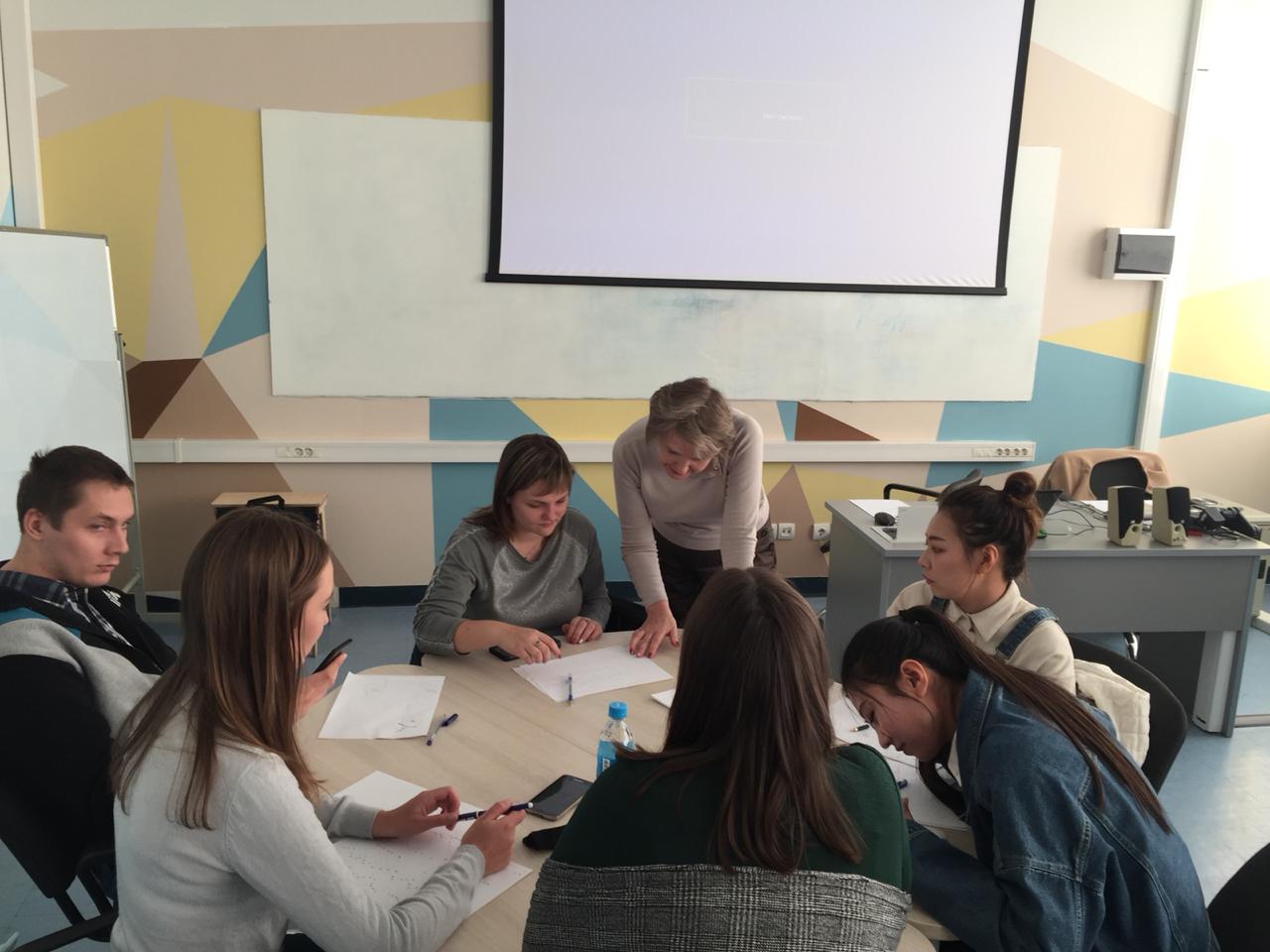
I've had an amazing three weeks in Russia at the Far Eastern Federal University at Vladivostok. I visited in March to deliver training to 20 teachers for a new course which myself and a small team devised called "Global Scientific Dialogue". The plan was to get those 20 teachers to deliver a similar programme to 200 students in October. It was a daunting task: working with teachers in concert with delivering an innovative course to students. The teacher development was very successful, and I was quite euphoric when I came back in March - but well aware that dealing with 200 students was a different kettle of fish. Now, I can say that the whole thing looks like it has been a big success, with some important implications for how we should approach educational development in institutions.

I'm pleased that most of the students (not quite all - but nearly!) really enjoyed the course, and many have expressed a sense of personal transformation through the experience (similar to the teachers in March). But more importantly, the teachers who I met in March have all been extremely positive about their experiences of teaching it - this has been transformative for them too. This is despite numerous technical issues, which bedevil any initiative of this kind, but which somehow has not dented the underlying philosophy or creative approach.

It makes me think that we need to look at the teacher-learner relationship as a "whole system" and make interventions with the whole system. Global Scientific Dialogue was really a cybernetic intervention: conversation drove the whole thing, supported by technology, but importantly, this was not the kind of technologically-supported conversation that dominates thinking about educational technology today (threaded discussions, etc). More importantly, the cybernetics that drove it was also part of the content (although I didn't labour the point!)

A whole system intervention is obviously not an intervention in the "parts" of teaching and learning which we usually attempt with silly things like "curriculum review", "teacher development" or what goes by the name of "technology-enhanced learning". I think there is no point in trying to develop teaching practice (or indeed curriculum) in isolation from the participation of students. Nor is there any point in trying to "bully" teachers into getting the best approval ratings from their students, or using the "latest technology". All of this simply depresses people. What we've done in Vladivostok is different: it was an intervention with everyone - teachers, learners and managers. It was an attempt to transform relationships and create the conditions for conversation. It worked.

How did we bring together teachers from management, economics, biology and tourism together to work on a single module which students could also participate in? Simply by focusing the educational content of the course on current scientific developments and questions "to which nobody currently knows the answer". So students and teachers passed through sessions focusing on "wicked problems", on current developments in quantum mechanics (and quantum biology), in AI, in social software, in intersubjectivity and interdisciplinarity. With there being no answer to any of this stuff, students and staff were encouraged to engage in creative activities. We used all sorts of things, from Mary Flannagan's brilliant "grow a game", to drama, music, art, data analysis and product innovation. We also had a special day where expert practitioners from biology, soil science, drama, music, genetics and many other disciplines, could be freely consulted by the students. This day was particularly successful because it opened the eyes of students too often imprisoned by subjects like management or economics which lose sight of the technological and scientific developments which fundamentally affect the context within which any management is conducted. This is a nice post written in English by one of the students the experts' session: https://maybeuseless.tumblr.com/post/179419474374/global-scientific-dialogue/amp

As in March, teaching activities were coordinated with a kind of video lesson plan - which worked very well in coordinating large numbers of students doing the same kinds of activities coordinated by different teachers. We also supplied the students with some comparative judgement software and a range of texts which were assembled around the different themes of the course. The software asked the students to simply say which of two texts (chosen at random) were most interesting to them: it was really an activity designed to encourage the student to read and think.




Assessment was a combination of this comparison activity and the presentation of a "patchwork text" which produced highly individualised work in presentation sessions which were some of the most uplifting things I have seen in education. Not all students liked it ("it was too much like kindergarten," was a common comment from those who didn't), but it seems the vast majority found the experience of being focused on collaborative activity with people they didn't know before was truly liberating and built a foundation for future collaboration.

I've been incredibly lucky in Russia: not simply that immediate colleagues have run with crazy ideas, but that we had powerful backing from the senior management in the school, who have not just been supportive, but have taken an active interest in the development of the course. Russia has yet to feel the full force of the ravages of marketisation (although there's plenty of it, of course). But it doesn't seem to have been paralysed by reductionist metrics in the way that many UK institutions seem to have become.

That's a worry for the UK HE sector. Personally, as someone who simply wants to make education better, I don't think it matters where positive interventions occur. Young people of all countries are the future of the world, and I am both deeply impressed and grateful for the wonderful work of colleagues and students at the Far Eastern Federal University. 

Thursday, 20 September 2018

Are Technological Solutions Possible for the Human Problem of Education? Reflections on Stiglitz's thoughts on AI

In the final dialogue between physicist David Bohm and spiritual guru, Jiddhu Krishnamurti, Krishnamurti focuses on how "human problems" can be solved, why it is that they persist, and whether humanity could ever live without any problems at all. He says:
“I am asking in this dialogue whether it is possible to have no human problems at all - only technological problems, which can be solved. But human problems seem insoluble. Is it because of our education, our deep-rooted traditions, that we accept things as they are?”
After some considerable soul-searching Bohm responds
“I wonder if we should even call these things problems, you see. A problem would be something that is reasonably solvable. If you put the problem of how to achieve a certain result, then that presupposes that you can reasonably find a way to do it technologically. But psychologically, the problem cannot be looked at in that way; to propose a result you have to achieve, and then
find a way to do it.”
Bohm’s insight highlights the fundamental dichotomy of educational technology. Technology in education is approached - by institutions, teachers, and learners - as a solution to a human problem. Yet the human problem of education is not one for which the result one wants to achieve can be specified in a simple way such that technology can be proposed as a solution. Most commonly, attempts to solve human problems in this way simply creates a deeper problem, and it is this to which Krishnamurti is drawing attention. Krishnamurti’s suspicion that education might be a cause of human problems - that education attempts to solve human problems through technological intervention - would suggest that some blame for the state of the world must sit at education’s feet.

Education is a human problem to which institutions attempt to find solutions. There are many dimensions to the human problem of education: the problem of making distinctions, the problem of conversation, the problem of institutional organisation, the problem of science and knowledge, the problem of openness, the problem of collective decision and judgement, the problem of economics, and the problem of research into education itself. The human problem of education is part of all these problems. The extent to which education seems to be an exacerbating factor in the production of these problems may partly be due to the fact that we do not possess a metalanguage for human problems: a way of talking about the connectedness of human problems.

And yet I wonder if we saw human problems from a different perspective, we might be able to look upon our situation in an organisational way which might help us to find a better way of living with the technologies which, so often, contribute to our problems. What if we had a meta-language of human problems?

This week Joseph Stiglitz argued that Artificial Intelligence was the world's greatest threat (see https://www.timeshighereducation.com/news/joseph-stiglitz-education-effort-post-war-scale-needed-ai), and a force which would lead the world to fascism. In response, what is needed, he argues, is a massive-scale amplification of education, to empower human critical faculties in being able to address the challenge of automated judgements and corporate surveillance.

There's some essence of truth in Stiglitz's message: the threat to society lies in the imbalance between machines and humans - but the temptation is to blame the machines themselves (Stiglitz seems to do this). In the end, it is not machines that replace jobs with automation; it is human institutions - businesses, corporations, institutions and their leaders - which do this. They do it, I believe, because they react to increased environmental uncertainty, which itself is created by technology.  The answer to address the imbalance between humans and machines is not to empower the institutions! The machines - and particularly AI - is powerful because it is organised in a different way to humans. It is a heterarchy (a word coined by the founder of machine learning, Warren McCulloch), whereas human institutions are hierarchies. The root of the human problem is institutions misunderstanding the nature of the threat from their environment and mis-adapting so that they exacerbate the problem. This  appears to be Stiglitz's solution unfortunately.

The core issue is that there are ways of organising human institutions which are not hierarchical. This would be to organise so as to manage the uncertainties created by technology, rather than seek to defend existing institutional structures against them (and in the process make it worse).

What is needed is a meta-language of human problems.  There are ways in which humans can look at their problems and address new ways of organising themselves, sometimes using technologies. In all crises in human history we see precisely this kind of movement - eventually... after humans have been sufficiently stupid in attempting simple "technological solutions" to problems that things get so bad that no other options appear to be available. If I am worried about the state of the world now, it is that I don't think really reached "Max Stupidity" yet.

Tuesday, 4 September 2018

What is it about mind which imputes the agency of a creator? What is it about nature which gives rise to a mind that does this?

According to constructivism, mind wouldn't work without some kind of stochastic process - there has to be some randomness (Bateson says this). That means that consciousness and life itself emerges from accident and what we understand as self-organising processes. One of the problems with this view is that it gives a very poor account of time. Obviously, accidents happen in time, and self-organisation happens in time, but time is taken as a given: it is not accounted for in the system.

Physics sees time, space, mass and energy as a kind of unity. Laws of conservation operate as if viewed from one angle, what we see is mass, viewed from another, its energy; from one angle its space, from another its time. But physics also understands that not all things are conserved. Mass is conserved, time isn't. Charge is conserved but space isn't. We understand these things in terms of those things which remain the same and those things which don't; between identity and non-identity.

Bohm regarded time as being "enfolded" in the laws of nature - what he saw as the "implicate order". What nature then presents to us is not a "process" operating over time, but a multi-dimensional structure which reveals time. What is meant by "structure" is an ordering of symmetry and asymmetry, and this order manifests itself throughout both nature and mind. It is, as Bohm susggested, holographic: within any part of consciousness or experience, there are symmetries that relate to the whole.

I'm currently writing about music. Music's diachronic symmetries and its synchronic symmetries are related. All that separates them is that the time dimension is magnified in the former, and not in the latter. When we talk about learning "processes" it may be the same - particularly so for learning conversations: what occurs over time is related to the structure at any single point. These dimensions: time, space, matter, energy, rotate into one another.

This is important whenever we feel compelled to construct stories about "origins". The structure of the story which unfolds in time is related to a kind of ordinal structure of categories which are used in the story. Religious stories and scientific stories about origins are the same in this regard. Science, however, looks for deeper reinforcement of the structure of its stories from empirical observation. In terms of evolutionary narratives this is difficult because nobody really sees evolution in action: all that is seen are the homologies between natural phenomena and the measurement of their historical emergence. But the scientific search for resonant patterns needn't stop with evolution and the fossil record. It can look everywhere - into art, education, cells, the universe and subatomic particles.

Science advances by closing-in on the coherence of pattern between mind and nature. Eventually I think we will understand that our very desire to pursue science and get deeper coherence is in itself part of the pattern.

Mind is driven to impute the agency of a creator because it is driven towards coherence with the way nature works. Nature works holographically, enfolding all the elements of human experience in a structure which is incorporated into physiology of consciousness, and the operation of mind itself.

Constructivism's overlooking of time leads to error and the assumption of accident. I doubt there are accidents...

Sunday, 2 September 2018

Beyond Left and Right: What would a safe and fair society look like with its Macbeths and Shylocks?

These are not normal times. It's hard to compose anything coherent to say. Every day I find myself feeling astonished by Trump - the cutting of funding to the Palestinians is just the latest horror. But it's on top of so many other horrors, we have become numb.

Brexit and the EU is really too confusing. How is a rational position even possible? No Brexit? Well, so you like being run by international bankers and corporations, do you? Isn't it all their fault in the first place? Brexit? Well, you'd like Boris Johnson for Prime Minister would you, and the country to turn into a tax haven? To hell with the lot of them.

Have the Whitehall mandarins made the best of things in coming up with a proposal? Would anyone else be able to handle the situation much better? I doubt it... just a bit hair-splitting. The thing is impossible. And nobody talks about what anyone wants at the end of whatever it is they are campaigning for. UKIP argued "Get out of the EU!"... ok, but what then? The government argued "Stay in the EU!"... ok, but what for? ("because leaving would be too disruptive" isn't a good answer)

I'd like a fairer society. I'd like people to feel safe for their whole lives, and have the confidence that their children weren't going to sink into the gutter because of the machinations of global finance. I'd like to feel confident that weather extremes weren't going to cause floods in the UK and war in the other parts of the world. I'd like everyone to feel open and welcoming to everyone else, and not to perceive others as a threat. I'd like people to be able to talk to each other about important things, and not contain anxieties in their own heads, where they are driven to mental illness and sometimes suicide.

So many of our problems stem from the fact that nobody feels safe any more. The guarantees of safety which were set up after the second world war have now been completely dismantled. Lose your job? You're pretty much on your own. The rich buy more houses than they need because they want their children to feel safe. Bosses increase their salaries and pensions to the hilt because they fear loss of security in old age. Yet, in the end, as Keynes said, "we're all dead".

The question "Is a world of global safety possible?" has been troubling me. I've been thinking about a more nuanced version: "Is a world where Shakespeare isn't true possible?" That question I am really struggling with.

Shakespeare didn't talk in terms of left and right. He understood the machinery of the human soul to such an extent that the play of human passion could be presented in a way which seems eternal. How does he do it? I suspect because he understood something about the universe: that patterns are written all the way through nature. That nature, as David Bohm would put it, is holographic.

Our political positions are abstract codifications of the human passions. What motivates us, what we are driven towards - love, truth, money, sex, glory, beauty, etc - becomes "political" at some level. But in becoming political, a lot gets left out. This is, I think, one of the reasons why there are so many financial and sex scandals in politics: the codification isn't real. The Left talk of "solidarity" - all the time knowing that "solidarity" is an abstraction, and that what is left out is what internal party politics is about (this is what is happening with Corbyn at the moment). The right talk of "profit" or "freedom of choice" - all the time knowing that nobody is really free to choose anything: again these are abstractions, rather like the "Brexit" which has provided the backdrop for the most extraordinarily febrile in-fighting in the Tories.

So what would a future safe society look like with the Macbeths and Shylocks who will inevitably inhabit it? That's the question.