Ivan Illich remarks that "Education creates failure". When we consider the double-bind that students are in with regard to education, failure is rarely spoken about. Certainly not in the student prospectus. Not in the interview with tutors before admission. And yet failure is the principal risk that can render huge personal expense worse than useless ("it would have been better if I'd never gone to university").
Universities won't talk about failure because it wants the students to come (in a marketised education system - interestingly it didn't used to be like this). Students won't talk about failure because they want to appear worthy of admission and want acceptance and fear rejection. So the system gears itself up around the prohibition of talk of failure.
But for widening participation students, failure and rejection is very common: but only after they've committed themselves. The institution might take a 'hit' from this in the form of its 'retention' statistics (another construct!), but not as much as the 'hit' which the learners are subjected to. And it's not even as if 'failure' is a clean break. If a student wants to leave after having failed but wants to be accredited with a part-award for what they have passed, they often have to retake (and re-fail) the requisite number of times (and pay for it). Such regulations can only be seen as ways of protecting the revenue of the University; it is clearly not in the student's interests.
In this way, failure is tied into the double-bind the students are in. A rational discussion about the risks of failure is not possible under these conditions.
What can be done about it?
I think in making it transparent about 'what you have to do to get a degree', including up-front assignments which can be inspected before entry, a rational judgement about the risks of failure can be made. This would make the discussion about the risks of failure possible, because it would be clear what the university expects for success. It would enable students to judge when they feel they are ready to be submitted to assessment. Most interestingly, much of the counselling discussion which takes place whilst the student is on the course, could occur before the student is submitted for assessment.

Thursday, 9 December 2010


Wednesday, 8 December 2010
Vote No! - Universities should not be allowed to rob the future generation!
The government's proposals for funding higher education are ill-judged and will have a devastating effect on students.
No one would invest £50k in something which is a leap of faith. Yet this is what will be demanded of the students by Universities if the legislation is passed. Universities will struggle to avoid being seen as shamanistic tricksters.
A better policy would be to put learners in control.
Learners need degrees to get on in life. To get a degree they have to study to pass exams and assignments. Universities should be up-front about what a learner needs to do to get their degree; at the moment they hide this away, so the learner only sees the dreaded (and often dreadful) assignments once they have paid-up - and by then it's too late. This is the rational bit of education: a degree is a necessary commodity today. If Universities were up-front, learners could make an informed decision about their chances of success, and the financial risk they would take on.
Learners ought to be able to choose the right teachers, the right social environment and the right lifestyle for them to be happy in their studies. These things are the fundamental 'human goods' of education. Learners should be able to take time to make these decisions; they should be able to make the wrong decision without onerous financial implications. They should be able to flexibly adjust how they engage with the university as their life circumstances permit.
Why does this not happen already?
Because we have been focussing not on the learner's problem, but on the institution's. Universities are not organised to operate like this. The institutions (at least, the posh ones) have argued "we can only continue in our current form by charging this much in this way!". The government has danced to their tune and our children are at great risk of being burdened with uncontrollable debt as a result. Were the vote to pass, Universities would share the culpability for this robbery with the banks.
Deal with the learner's problem and organisational change in universities is inevitable. Redundancies are inevitable. But it would be the right thing to do: it would put learners in control.
No one would invest £50k in something which is a leap of faith. Yet this is what will be demanded of the students by Universities if the legislation is passed. Universities will struggle to avoid being seen as shamanistic tricksters.
A better policy would be to put learners in control.
Learners need degrees to get on in life. To get a degree they have to study to pass exams and assignments. Universities should be up-front about what a learner needs to do to get their degree; at the moment they hide this away, so the learner only sees the dreaded (and often dreadful) assignments once they have paid-up - and by then it's too late. This is the rational bit of education: a degree is a necessary commodity today. If Universities were up-front, learners could make an informed decision about their chances of success, and the financial risk they would take on.
Learners ought to be able to choose the right teachers, the right social environment and the right lifestyle for them to be happy in their studies. These things are the fundamental 'human goods' of education. Learners should be able to take time to make these decisions; they should be able to make the wrong decision without onerous financial implications. They should be able to flexibly adjust how they engage with the university as their life circumstances permit.
Why does this not happen already?
Because we have been focussing not on the learner's problem, but on the institution's. Universities are not organised to operate like this. The institutions (at least, the posh ones) have argued "we can only continue in our current form by charging this much in this way!". The government has danced to their tune and our children are at great risk of being burdened with uncontrollable debt as a result. Were the vote to pass, Universities would share the culpability for this robbery with the banks.
Deal with the learner's problem and organisational change in universities is inevitable. Redundancies are inevitable. But it would be the right thing to do: it would put learners in control.
Tuesday, 7 December 2010
Services, Value and the Human goods of Education
In my video yesterday I tried to apply my thinking about value to understanding what's happening with the servitised economy. My conclusions from this are:
The human good of education is always a leap of faith: faith that the teaching you receive will meet your needs and transform your capabilities; faith that the degree you earn will improve your life chances; faith that people you meet will become friends and you'll have a good time; faith that the subject you study you will really enjoy in all its depth. There are, however, no guarantees about any of this. The link between the human good of education and faith is instructive: it may be that where the value of commodities and services, intrinsic or otherwise lies in reason, the value of human goods lies in faith.
This is important because it highlights the category error when we talk about the 'investment' and 'price' of education and the servitisation of knowledge. Servitisation of knowledge and education leads to an association with a financial transaction. Financial investments and price belong to the world of commodities and services (like banking) which can be rationalised, risks assessed, etc. Human goods, in being bound to faith, are a challenge for reason because the risks are so high and yet the desire, borne out of simply being human is nevertheless so great: it is a very irrational transaction.
To demand individuals make rational financial decisions about human goods is to trap them in a 'double-bind' of the kind which is more often found in religious cults.
The nature of the double-bind is this:
1. Education will set you free! (for a price...)
2. Financial impoverishment and submission to institutional assessment will enslave you (but education will set you free... and so on)
...and discussing your imprisonment by education is to admit failure
so...
- that 'intrinsic value' of a commodity is intransitive (i.e. is objective) and when the intrinsic value is distibuted amongst the people, there is a greater share of individual control and empowerment since this intrinsic value can be passed around individuals at their will.
- if a commodity with intrinsic value is servitised, its intrinsic value is taken away from the people and concentrated in the hands of a few. The value of a service is far more transitive than the intrinsic value of a commodity. The mechanisms of the value of a service are largely controlled by the controllers of the service, not by the people (although the people determine the demand for the service, but not by organised conscious action, but rather through collective unconscious behaviour). The controllers of the service will use the intrinsic value of the commodities they acquire to control the value of the services they provide. The people lose control and freedom.
The human good of education is always a leap of faith: faith that the teaching you receive will meet your needs and transform your capabilities; faith that the degree you earn will improve your life chances; faith that people you meet will become friends and you'll have a good time; faith that the subject you study you will really enjoy in all its depth. There are, however, no guarantees about any of this. The link between the human good of education and faith is instructive: it may be that where the value of commodities and services, intrinsic or otherwise lies in reason, the value of human goods lies in faith.
This is important because it highlights the category error when we talk about the 'investment' and 'price' of education and the servitisation of knowledge. Servitisation of knowledge and education leads to an association with a financial transaction. Financial investments and price belong to the world of commodities and services (like banking) which can be rationalised, risks assessed, etc. Human goods, in being bound to faith, are a challenge for reason because the risks are so high and yet the desire, borne out of simply being human is nevertheless so great: it is a very irrational transaction.
To demand individuals make rational financial decisions about human goods is to trap them in a 'double-bind' of the kind which is more often found in religious cults.
The nature of the double-bind is this:
1. Education will set you free! (for a price...)
2. Financial impoverishment and submission to institutional assessment will enslave you (but education will set you free... and so on)
...and discussing your imprisonment by education is to admit failure
so...
Institutions must address the learner's problem!
Monday, 6 December 2010
The redescription of educational reality
There is something mad about education. The madness is made more apparent when those who are part of the system which is to blame for the current crisis vocally support the student protests against the political response to that crisis.
I think there is a problem with those who are part of the system "protesting". The students ought to be protesting against them too: "what do you do that's worth £9000 a year of public (or my) money?" It's a good question isn't it?
I'm interested in the madness because the protesters (students and 'insiders') seem to balance each other out. Their values deep down are conflicting, and the end result is a sort of impotence which guarantees some degree of stability. Of course, if the protesters sorted out the inconsistencies in the deep values of those who support them, then as I said yesterday, they would win a victory. But let's assume they don't do this. What will happen? My guess is the protests will peter out, particularly in response to minor concessions. The system will remain stable. Education may remain unchanged. Some universities will become even more powerful (that's ominous!). Students will reluctantly pay their fees. Bad debts will occur in the future, but that's tomorrow's problem.
Pathology in individuals is borne out of confusion: an inability to unpick the double-binds that we are tied up in. In cybernetics, Ashby tells us about 'requisite variety': that only variety (the number of states a system can exist in) can absorb variety. But the logical consequence of this is 'requisite pathology'. A pathological system occurs when variety is out of control, and this can happen with confusion and crisis. But one mad individual may provide the requisite variety for another mad individual thus producing a stable system. This may be what happens with the protests.
Requisite pathology I think is a realistic way of looking at the world. It has something in common with Kauffman's idea of the 'edge of chaos'. Most cyberneticians like to think that variety can be managed in a rational way which can be planned for. But how variety is really managed is much more complex, multi-layered and dependent on social dynamics which defeat the best attempts to engineer all-in 'solutions'.
I think if we really want to change the education system, we need to understand the mechanisms of requisite pathology. Ultimately, new categories are required which can help individuals identify the double-binds they are caught in. Historical figures who effect massive social transformation do it through a process of redescription, allowing individuals to untie themselves from their current pathologies (of course, over time they create new ones!). Jesus and Marx are good examples. Jesus brought new categories about love and freedom; Marx brought new categories about work and equality. What redescription can address our current pathologies?
I think there is a problem with those who are part of the system "protesting". The students ought to be protesting against them too: "what do you do that's worth £9000 a year of public (or my) money?" It's a good question isn't it?
I'm interested in the madness because the protesters (students and 'insiders') seem to balance each other out. Their values deep down are conflicting, and the end result is a sort of impotence which guarantees some degree of stability. Of course, if the protesters sorted out the inconsistencies in the deep values of those who support them, then as I said yesterday, they would win a victory. But let's assume they don't do this. What will happen? My guess is the protests will peter out, particularly in response to minor concessions. The system will remain stable. Education may remain unchanged. Some universities will become even more powerful (that's ominous!). Students will reluctantly pay their fees. Bad debts will occur in the future, but that's tomorrow's problem.
Pathology in individuals is borne out of confusion: an inability to unpick the double-binds that we are tied up in. In cybernetics, Ashby tells us about 'requisite variety': that only variety (the number of states a system can exist in) can absorb variety. But the logical consequence of this is 'requisite pathology'. A pathological system occurs when variety is out of control, and this can happen with confusion and crisis. But one mad individual may provide the requisite variety for another mad individual thus producing a stable system. This may be what happens with the protests.
Requisite pathology I think is a realistic way of looking at the world. It has something in common with Kauffman's idea of the 'edge of chaos'. Most cyberneticians like to think that variety can be managed in a rational way which can be planned for. But how variety is really managed is much more complex, multi-layered and dependent on social dynamics which defeat the best attempts to engineer all-in 'solutions'.
I think if we really want to change the education system, we need to understand the mechanisms of requisite pathology. Ultimately, new categories are required which can help individuals identify the double-binds they are caught in. Historical figures who effect massive social transformation do it through a process of redescription, allowing individuals to untie themselves from their current pathologies (of course, over time they create new ones!). Jesus and Marx are good examples. Jesus brought new categories about love and freedom; Marx brought new categories about work and equality. What redescription can address our current pathologies?
Sunday, 5 December 2010
Student Protests, Universities and the Servitisation of Knowledge
Currently students are protesting in the UK at having their fees increased threefold and a burden of debt to last until they are in their 50s. Most people would put up a fight if someone lumped a £50k debt on them. The students are rightly angry, arguing that there's a principle at stake (more than their own personal loss) - but what is it? Their protest is unfortunately threatened by the inability to focus their fire. However, if they can nail the 'principle' then I think, because they have such self-organising power for collective action, they could have a spectacular victory.
The 'principle' is, I suspect, to do with freedom and equality and establishment's failure to deliver either. There are signs that the activism is moving in this direction. The #UKuncut (http://www.ukuncut.org.uk) campaign is targetting tax-evading high street stores with the slogan "pay your tax!". That's pretty unambiguous and might have some mileage.
The issue of freedom is I think directly related to education. Universities can be places to go to think and talk freely, away from the pressures of working life. Free talk in working life is rarely that free: there are so many unaskables, unthinkables in most corporations large and small: where the watchword is profit, the doublethink and newspeak will squash the thinking and the intense hours, the high mortgage, the daily commute and the demanding family will squash the will. This is not healthy. University is a place where the human good of expressive freedom can be attained and converted into a social good: although Universities themselves need to continually examine the extent to which they deliver this (students - beware what you wish for - the institution of education is at much at fault as big business!)
The equality principle is not only about the gap between the rich and the poor, but also the comparative freedoms between generations. If freedom is measured by one's ability to control one's destiny through being empowered to make informed choices from a range of options then we can situate the issue of debt with regard to personal control. It is not necessarily true that debt is bad. But only under the conditions where individuals have freedom to choose how much debt they should take on, what they will gain, and how they can manage it. Financial constriction and privation can sometimes yield greater human rewards (just as artistic constrictions can yield greater art); the social responsibility that goes with financial burden can also be good. The proposed loan arrangements for students impose huge debt with little control. This is in contrast to the financial freedoms enjoyed by the parents and grandparents of the current students, where there was plenty of scope for well-judged financial decisions which have paid-off handsomely in their retirement. These control levers are simply not available to the students, and ladling more debt on them will only make things worse.
Part of the blame for this I think is the increasing servitisation of the economy: moving from products to services has meant moving from artefacts which have intrinsic value which can be transferred, to artefacts which have no value to be transferred, but which are merely vehicles for consuming services. It's not just mobile phones (although that's a classic example) - there's an increasing trend to servitise everything from houses to rubbish collection. This servitisation has accompanied the collapse of manufacturing as a major employer, thus many of the jobs which students will end up doing will ultimately be in these 'servitised conversions'. A common feature of these services is the need to establish long-term legal contracts with consumers to ensure sufficient revenue for the service provider: consequently, people find themselves 'trapped' in long-term binding financial arrangements. But servitisation has a further trick, which has much greater impact. For in transferring the intrinsic value artefact to the service-consuming artefact, the intrinsic value has not disappeared. It has been swallowed up by the service providers who leverage the intrinsic value of products to extort greater custom for their services. They consequently have been getting more wealthy. It is not unusual in big cities to find streets where residential houses are aggressively purchased by developers, only for those houses to be demolished and flats (which service contracts) built in their place. In this way, the intrinsic value of artefacts gets transferred to a few. Servitisation may be the single most important driver behind the widening gap between rich and poor.
In the same way, we can consider the intrinsic value of an education. The intrinsic value of education is knowledge. It is knowledge that gives people the flexibility to make informed choices in their lives. I think the universities have succeeded in turning knowledge into a service. It's interesting to see the British Library (http://www.bl.uk) trumpeting the 'value of knowledge' whilst selling 'services' to 'discover' it. Universities similarly sell services to discover knowledge in the form of courses. But a learning service is not knowledge, nor does it always deliver knowledge - as many dissatisfied consumers of learning services will testify. Indeed, learning services in the form of assessments and lectures can actually work against the discovery of knowledge. What learning services do deliver is the maintenance of the institution which keeps the service running. In this sense, the University's servitisation of knowledge is comparable to the servitisation of products by big business. The end-result is that Universities get more wealthy and powerful.
Educational institutions are large employers and economically important in their local communities. In a post-manufacturing economy, there is a requirement to generate need for the services that the institutions provide. Thus, it is increasingly hard to find employment in any of the service industries without having first consumed 'learning services' of one kind or another. In such a situation, does it matter who pays for it? If the need has been manufactured by society, and individuals can't get on in the world without consuming learning services, they have no choice but to stump up and pay their £50k. The students know this - that's why they're upset. So what can they do about it?
The issue centres on the intrinsic value of knowledge and the flexibility with which it can be accessed. The problem is that knowledge ultimately is discovered within the individual, not transferred by an institutional service. Universities have servitised knowledge but they have been able to do this because the service industries demand consumption of learning services as a condition of employment. The learning services the universities offer are very inflexible and expensive. The universities consider that their offering has to be like this to guarantee their revenue. But knowledge comes through care, space, communication, access to top professors, activity with peers, reading, etc. Not to mention a certain degree of suffering (but not too much!). So why don't the Universities ask how an individual might:
a. become knowledgeable
b. make their way through the world
c. contribute to the sustainability of knowledge for following generations
... without having to consume the existing services of a university?
The resistance to such thinking results from the pathology of universities in wishing to maintain themselves and their services. But it's only by a trick that Universities have swallowed knowledge and servitised it. Their wealth has been given to them by the service economy because it is in the broader economy's interests to maintain the educational services sector. But carrying on like this will lead to the enslavement of the future generation and possibly a worrying de-privileging of knowledge in society. Is there a way out?
Maybe we should have a fresh look at those aspects of the acquisition of knowledge:
1. care
2. space
3. communication
4. access to top professors
5. reading
6. activity with peers
I don't think this can all happen online. But technology can facilitate human contact that is necessary for much of it. Ironically, the protesting students taste of solidarity might be the best education they get! Maybe the protesters should consider forming their own university?
The 'principle' is, I suspect, to do with freedom and equality and establishment's failure to deliver either. There are signs that the activism is moving in this direction. The #UKuncut (http://www.ukuncut.org.uk) campaign is targetting tax-evading high street stores with the slogan "pay your tax!". That's pretty unambiguous and might have some mileage.
The issue of freedom is I think directly related to education. Universities can be places to go to think and talk freely, away from the pressures of working life. Free talk in working life is rarely that free: there are so many unaskables, unthinkables in most corporations large and small: where the watchword is profit, the doublethink and newspeak will squash the thinking and the intense hours, the high mortgage, the daily commute and the demanding family will squash the will. This is not healthy. University is a place where the human good of expressive freedom can be attained and converted into a social good: although Universities themselves need to continually examine the extent to which they deliver this (students - beware what you wish for - the institution of education is at much at fault as big business!)
The equality principle is not only about the gap between the rich and the poor, but also the comparative freedoms between generations. If freedom is measured by one's ability to control one's destiny through being empowered to make informed choices from a range of options then we can situate the issue of debt with regard to personal control. It is not necessarily true that debt is bad. But only under the conditions where individuals have freedom to choose how much debt they should take on, what they will gain, and how they can manage it. Financial constriction and privation can sometimes yield greater human rewards (just as artistic constrictions can yield greater art); the social responsibility that goes with financial burden can also be good. The proposed loan arrangements for students impose huge debt with little control. This is in contrast to the financial freedoms enjoyed by the parents and grandparents of the current students, where there was plenty of scope for well-judged financial decisions which have paid-off handsomely in their retirement. These control levers are simply not available to the students, and ladling more debt on them will only make things worse.
Part of the blame for this I think is the increasing servitisation of the economy: moving from products to services has meant moving from artefacts which have intrinsic value which can be transferred, to artefacts which have no value to be transferred, but which are merely vehicles for consuming services. It's not just mobile phones (although that's a classic example) - there's an increasing trend to servitise everything from houses to rubbish collection. This servitisation has accompanied the collapse of manufacturing as a major employer, thus many of the jobs which students will end up doing will ultimately be in these 'servitised conversions'. A common feature of these services is the need to establish long-term legal contracts with consumers to ensure sufficient revenue for the service provider: consequently, people find themselves 'trapped' in long-term binding financial arrangements. But servitisation has a further trick, which has much greater impact. For in transferring the intrinsic value artefact to the service-consuming artefact, the intrinsic value has not disappeared. It has been swallowed up by the service providers who leverage the intrinsic value of products to extort greater custom for their services. They consequently have been getting more wealthy. It is not unusual in big cities to find streets where residential houses are aggressively purchased by developers, only for those houses to be demolished and flats (which service contracts) built in their place. In this way, the intrinsic value of artefacts gets transferred to a few. Servitisation may be the single most important driver behind the widening gap between rich and poor.
In the same way, we can consider the intrinsic value of an education. The intrinsic value of education is knowledge. It is knowledge that gives people the flexibility to make informed choices in their lives. I think the universities have succeeded in turning knowledge into a service. It's interesting to see the British Library (http://www.bl.uk) trumpeting the 'value of knowledge' whilst selling 'services' to 'discover' it. Universities similarly sell services to discover knowledge in the form of courses. But a learning service is not knowledge, nor does it always deliver knowledge - as many dissatisfied consumers of learning services will testify. Indeed, learning services in the form of assessments and lectures can actually work against the discovery of knowledge. What learning services do deliver is the maintenance of the institution which keeps the service running. In this sense, the University's servitisation of knowledge is comparable to the servitisation of products by big business. The end-result is that Universities get more wealthy and powerful.
Educational institutions are large employers and economically important in their local communities. In a post-manufacturing economy, there is a requirement to generate need for the services that the institutions provide. Thus, it is increasingly hard to find employment in any of the service industries without having first consumed 'learning services' of one kind or another. In such a situation, does it matter who pays for it? If the need has been manufactured by society, and individuals can't get on in the world without consuming learning services, they have no choice but to stump up and pay their £50k. The students know this - that's why they're upset. So what can they do about it?
The issue centres on the intrinsic value of knowledge and the flexibility with which it can be accessed. The problem is that knowledge ultimately is discovered within the individual, not transferred by an institutional service. Universities have servitised knowledge but they have been able to do this because the service industries demand consumption of learning services as a condition of employment. The learning services the universities offer are very inflexible and expensive. The universities consider that their offering has to be like this to guarantee their revenue. But knowledge comes through care, space, communication, access to top professors, activity with peers, reading, etc. Not to mention a certain degree of suffering (but not too much!). So why don't the Universities ask how an individual might:
a. become knowledgeable
b. make their way through the world
c. contribute to the sustainability of knowledge for following generations
... without having to consume the existing services of a university?
The resistance to such thinking results from the pathology of universities in wishing to maintain themselves and their services. But it's only by a trick that Universities have swallowed knowledge and servitised it. Their wealth has been given to them by the service economy because it is in the broader economy's interests to maintain the educational services sector. But carrying on like this will lead to the enslavement of the future generation and possibly a worrying de-privileging of knowledge in society. Is there a way out?
Maybe we should have a fresh look at those aspects of the acquisition of knowledge:
1. care
2. space
3. communication
4. access to top professors
5. reading
6. activity with peers
I don't think this can all happen online. But technology can facilitate human contact that is necessary for much of it. Ironically, the protesting students taste of solidarity might be the best education they get! Maybe the protesters should consider forming their own university?
Thursday, 2 December 2010
On the possibility of mimicry
I watched my daughter yesterday in a short show at her drama group: she had to put on accents, pretend to be different types of people, etc. She also demonstrated an acute sense of comic timing - something which has become more apparent in recent months, and which will no doubt grow as she gets older (she's 10). When she realises the laughs she gets in response to the things she does, how will that lead her to develop? How has she managed to pick up all those behaviours and accents and combine them into a comic performance? As much as I'm proud of her (and there's little more moving than watching one's child perform like this), I'm puzzled by how this is possible.
I don't know of a satisfactory explanation for mimicry, What does the fact that we mimic tell us about the world? Yesterday I suggested that to mimic is to reproduce the skilled articulations of somebody else's performance. And I suggested that it is remarkable that we can identify exactly what those independent articulations are. For what we are exposed to in a performance is like a 'wave' which sweeps us along: the whole which is more than the sum of the parts. It is our identification of the the parts through experiencing this 'wave' together with the realisation of how to reproduce them which strikes me as the remarkable bit.
The central question here is "what are the mechanisms of modelling?". I think it also relates to the question of 'family resemblance' which Wittgenstein identified. In short, this is the sort of thing I'm thinking about (thanks Katy!):
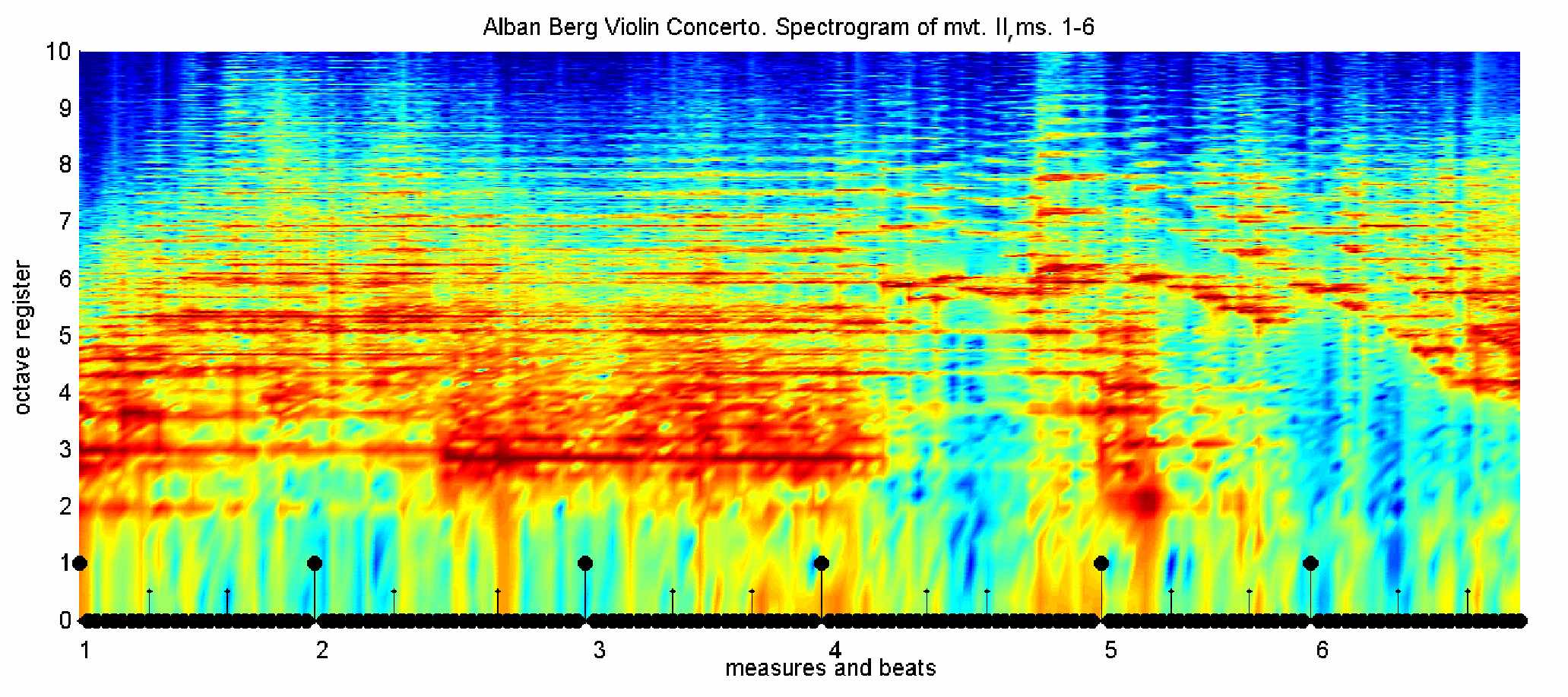
A 'wave' impacts in broad ways - it's mass of different articulations striking us to produce an overall effect. A musical analogy is perhaps the best way to describe this. A 'spectral' graph of a moment in music looks something like this:
 Within that graph, all the articulations are present but overlapping. Imagine the graph represents all the levels of double-description (double-articulation) in a 'knowledge performance' which might be mimicked. My state on being exposed to the 'wave' of the performance might be analogous to my state on hearing Berg's violin concerto (above): most broadly, I will have been disrupted, exhorted, coerced at different moments. At each moment I will be aware of the physical/biological effects of the state I am put into. My biological challenge on being exposed to the wave is to make successful communications in its presence (which are in turn linked to the wellbeing of my state). In music this would be revealed by the empathy with the expression and intention of the composer. In a knowledge performance, it would be the empathy with the performer. If I choose to survive in the environment of the wave (and I can decide it's not to my taste), then making articulations which accord with the articulations that I experience increases the probability that I can communicate effectively in this environment, and that the environment will not perturb my system to put me in a state where I could not communicate.
Interest leads me to identify the articulations, and the interest is borne out of the necessity to survive in the context, which in turn depends on the choice that I have made that this is something which I want to exist with. Thus my state produced by the overall effect of disruption, exhortation and coercion leads to a chain reaction of apprehension of individual details of articulations, awareness of the biological effects of those articulations, and explorations of those articulated performances in my own body. It is a chain reaction in much the same way as I think memory might be (see here)
This would not work if I could not identify some family resemblance between the articulations I perceive and those which I perform. But maybe the family resemblance lies in the prolongation of state?
Gosh - that's all very dense. I think perhaps I need to find a way to say this more simply!
I don't know of a satisfactory explanation for mimicry, What does the fact that we mimic tell us about the world? Yesterday I suggested that to mimic is to reproduce the skilled articulations of somebody else's performance. And I suggested that it is remarkable that we can identify exactly what those independent articulations are. For what we are exposed to in a performance is like a 'wave' which sweeps us along: the whole which is more than the sum of the parts. It is our identification of the the parts through experiencing this 'wave' together with the realisation of how to reproduce them which strikes me as the remarkable bit.
The central question here is "what are the mechanisms of modelling?". I think it also relates to the question of 'family resemblance' which Wittgenstein identified. In short, this is the sort of thing I'm thinking about (thanks Katy!):
A 'wave' impacts in broad ways - it's mass of different articulations striking us to produce an overall effect. A musical analogy is perhaps the best way to describe this. A 'spectral' graph of a moment in music looks something like this:
Interest leads me to identify the articulations, and the interest is borne out of the necessity to survive in the context, which in turn depends on the choice that I have made that this is something which I want to exist with. Thus my state produced by the overall effect of disruption, exhortation and coercion leads to a chain reaction of apprehension of individual details of articulations, awareness of the biological effects of those articulations, and explorations of those articulated performances in my own body. It is a chain reaction in much the same way as I think memory might be (see here)
This would not work if I could not identify some family resemblance between the articulations I perceive and those which I perform. But maybe the family resemblance lies in the prolongation of state?
Gosh - that's all very dense. I think perhaps I need to find a way to say this more simply!
Wednesday, 1 December 2010
Knowledge, Performance and Positioning
let's assume we perform the things we know...
I think I can address some of these now.
Revealing who we are is related to the authenticity of the performance. It is a description about the ethos of knowledge: "this is worthwhile because..."
Artefacts are created through a performance which creates content. Artefacts themselves contain different descriptions which can be analysed at a semiotic level (marks on the paper, words, brush strokes, picture, motifs, melodies, etc)
We are usually part of a performance because the performance is coordinating an 'agency game'. We learn the rules of the game; we learn the articulations of the performance (for example, learning to sing a song)
It's the agency game that counts. A teacher's performance of knowledge is really a coordination of an agency game - with learners, on their own. Learners learn to play the game by learning its rules, by learning the articulations of the performances of the teacher.
Mimicry is extraordinary. To mimic I must be able to deduce (or abduct) how it is that the overall knowledge performance is articulated: what skilled performances are required, how they are produced, how I can produce them, how they are coordinated, how I can coordinate them, and so on. How is it that I deduce from a musical performance the articulations of skilled performance I need to perform to reproduce it? Mimicing accents or personalities is even more complex. Yet we seem to be able to do this easily. Somehow my biological state can apprehend the agency that caused it to come about.
Positioning is important. It may be related to taste. Not all performances are to my taste. I might love Haydn and detest Boulez. I would not seek to reproduce the skilled performances of Boulez. It relates to my capacity to engage in the agency games with either Haydn (or using Haydn) and Boulez. My position detects the likelihood that I can engage in the agency game successfully in my current state. A teacher might similarly find a student not to their taste: they judge that they cannot engage in a meaningful agency game with them because the skilled performances the student can do does not match the game the teacher wants to play. Good teachers will change the game and find one the student can play.
To what extent is performing the things we know related to revealing who we are?
How does the type of performance relate to the artefacts we produce?
How to artefacts relate to the performances that are created?What do we learn from a performance?
Do we learn the knowledge, or do we learn how to perform the knowledge?What are the conditions for mimicry?
How does performing the things we know relate to the ways we treat others?I think I can address some of these now.
Revealing who we are is related to the authenticity of the performance. It is a description about the ethos of knowledge: "this is worthwhile because..."
Artefacts are created through a performance which creates content. Artefacts themselves contain different descriptions which can be analysed at a semiotic level (marks on the paper, words, brush strokes, picture, motifs, melodies, etc)
We are usually part of a performance because the performance is coordinating an 'agency game'. We learn the rules of the game; we learn the articulations of the performance (for example, learning to sing a song)
It's the agency game that counts. A teacher's performance of knowledge is really a coordination of an agency game - with learners, on their own. Learners learn to play the game by learning its rules, by learning the articulations of the performances of the teacher.
Mimicry is extraordinary. To mimic I must be able to deduce (or abduct) how it is that the overall knowledge performance is articulated: what skilled performances are required, how they are produced, how I can produce them, how they are coordinated, how I can coordinate them, and so on. How is it that I deduce from a musical performance the articulations of skilled performance I need to perform to reproduce it? Mimicing accents or personalities is even more complex. Yet we seem to be able to do this easily. Somehow my biological state can apprehend the agency that caused it to come about.
Positioning is important. It may be related to taste. Not all performances are to my taste. I might love Haydn and detest Boulez. I would not seek to reproduce the skilled performances of Boulez. It relates to my capacity to engage in the agency games with either Haydn (or using Haydn) and Boulez. My position detects the likelihood that I can engage in the agency game successfully in my current state. A teacher might similarly find a student not to their taste: they judge that they cannot engage in a meaningful agency game with them because the skilled performances the student can do does not match the game the teacher wants to play. Good teachers will change the game and find one the student can play.
Subscribe to:
Posts (Atom)