Monday, 4 December 2017

The Computer Programmer's Superego and Mental Illness

The second book of Ehrenzweig's Hidden Order of Art makes reference to imagery in Frazer's Golden Bough and relates it to Freudian interpretation. It's a move of some brilliance because it presents the primeval mythological forces that all art draws on and relates them to an understanding of therapy and conscious life. He begins chapter 13 by making a bold statement about the role of the superego over the ego:
The exact role of the superego's aggression in creative work will probably be fully understood only when we have found out more about its role in causing mental illness. In many ways creativity and mental illness are opposite sides of the same coin. The blocking of creativity through ego rigidity is apt to unleash the self-destructive fury of the superego, which is otherwise absorbed and neutralized by the periodic decomposition of the ego during creativity. An increased measure of the superego's oral and anal aggression against the ego is utilized for deepening the normally shallow oscillation of the ego as it swings down to less differentiated levels. 
When Ehrenzweig uses Freudian terminology like "oral" and "anal" aggression, he is referring to processes of attenuation and assertion of distinctions. Sometimes the superego breaks down the distinctions of the ego and drives them into the unconscious: Ehrenzweig calls this "anal scattering", after the anal stage of development where the child doesn't control their bowel movements. Alternatively, the superego can cause rigidity in the ego by becoming authoritarian in the distinctions that are made: Ehrenzweig calls this "containment". Deeper delving into the unconscious "undifferentiated levels" (the primary process) occurs through a process of generating and enforcing new distinctions: scattering melts things down, containment gathers things up. New distinctions drill deeper into the undifferentiated levels, drawing up new material for the conscious mind to work on. He continues:
The superego's anal scattering attacks drive the ego inexorably towards an extreme oceanic depth until the process of dedifferentiation even suspends the distinction between ego and superego. Then the ego can shake itself free from the superego's aggression. 

This is the creative struggle which all artists and scientists must deal with. Insanity, Ehrenzweig argues, "may be creativity gone wrong" (Ch.15, p257).

Since I've been doing a lot of computer programming recently, I'm asking myself where computer programming sits in this creative process. Is it creative in the same way that Picasso was creative? Does it probe the oceanic depths of consciousness and bring forth new distinctions? In much recent writing about creativity, the consensus seems to be that creativity in software is the same as creativity in art; the designs of Apple Corp are creative in the same way that Jackson Pollock was. Coupled with this question is a question about why I personally have found it so difficult to compose music using technology (which I will write about in a later post, inspired by Marion Milner's "On being unable to Paint").

The deep question in this stuff is "where do distinctions come from?". In forms of activity like computer programming, distinctions are normatively defined: the syntax of a langauge, the right way of doing something, the threats of doing it wrong, and so on. Are the normative distinctions of code the same as the affordances of paint, or the properties of sound?

I don't think they are. The difference, I believe, has to do with singularity and multiplicity of distinction. A sound comprises many distinctions (many frequencies, for example); paint has many properties including viscosity, colour, luminosity, and so on. In the logic of code, syntax is syntax - formally defined in the rulebook of the language: there is not multiplicity at a deep level, and there is not flexibility for redefining it. All great painting redefines paint at some level or other. In Ehrenzweig's language, the material is scattered, dedifferentiated, and then contained and reconstructed.

It is possible to code like this, but it is not what most people would take to be computer programming. It is the difference between the sculptor working with metal girders to create some new edifice, and the architect working with girders to create a bridge which won't fall down.

The superego of the computer programmer is the compiler + the expectation of the customer. Both of these are containing forces, and their pressure causes a rigidity of the ego. I find myself, when I am subject to these forces and writing code, that my creative spirit dries up. It's interesting to reflect that much of education - even creative education - has this same dessicating effect. The result is mental anxiety and stress which we've learnt to put down to modern life, but which is really a symptom of ego dissociation and madness.

Could we escape this? Could our manipulation of symbols be a scattering as well as a containing? I'm beginning to see this as a very important question regard the human relationship with technology. 

Wednesday, 29 November 2017

The Psychoanalysis of Institutional Madness

So, Glynis Breakwell has gone (see http://www.bbc.co.uk/news/education-42152743). The arrogance of superiority finally got her. How many others now, I wonder? I suspect other VCs, including my favourite - George Holmes at the University of Bolton - will be glad that the axe has fallen, blood has been spilled, and hopefully the whole "What the fuck are you paid?" thing dissipates. It won't. The reason is because it's not about money, or even about corruption: it's about hierarchy. Inflated salaries and corruption (of which there are both) are symptoms of hierarchy and the pathology whereby hierarchies are seeking to reinforce themselves in an environment which is ever-more ruled by uncertainty and ambiguity.

I've become more interested in this on a psychoanalytic level. Freudian language gave us the idea of "anal retention", and basically, this is what we see from all those at the top of institutions. They are so bound by "rules" and "prescriptions" - what Freud calls the domination of the superego over the ego, that they are afraid of expressing themselves freely - just as the child who is chided for shitting inconveniently will seek to withhold their bowel movements. This has another effect too - the anal retentive will find other, more sinister ways of expressing their libidinous instinct. Harvey Weinstein was the top of a hierarchy, he was anally retentive and his sexual predation was driven by a need to descend to the unconscious and dark level to expel all the shit that had been building up. I'm wondering if this isn't going on in all hierarchies.

Hierarchy is a fossil of human organisation. It was an established social structure which could deal with the uncertainties of life. It was formed against a context of communication which was largely restricted: before print (and what a difference print made!) hierarchy served as a route for society to manage its uncertainty through institutions like the church, government and the universities. Alongside it went deference, the law, torture, and military power.

Technology has given us untrammelled growth in uncertainty. Hierarchies are tied to a pathological positive feedback mechanism: they use technologies to help to manage uncertainty, but in doing so feed the uncertainty which they attempt to deal with.

Stafford Beer, in Platform for Change, has some fascinating diagrams. They are all tripartite: there is an institution, or a thing-with-identity, there is uncertainty arising from that thing-with-identity, and there is a function which seeks to manage the uncertainty. It looks like this (these are my versions). So religion might look like:
 But then I was thinking how similar this looks to the relation between the Ego, the Id and the Superego in Freud:
Where does Beer go with this? Well, he says that the metasystem is pathological: the superego eats the ego (as Freud says), and the Catechism rules the religion. How do we solve this? We need a new metalanguage. 

For a psychotherapy, I was wondering what the metasystem might be. I have come up with something like this:
I might add "Metalanguage of global consciousness and creativity."... Ehrenzweig's "Hidden order of art" is taking on a new significance for me.


Tuesday, 28 November 2017

Empirical Phenomenology

How much time do we spend staring at oblongs? As I'm writing this, I am staring at an oblong - a black border with lights in the middle. When I look at my phone, its the same thing - and in fact, the extent to which the oblong fills my field of view is roughly the same, since I hold the phone closer to me. Do we know what prolonged oblong exposure does to people?

I asked my 17 year old daughter. She said, "but you look at windows, you don't worry about that.." I said, "I never look at windows. I look through them. It's different".

We have amazing technologies for exploring the phenomenology of perception in a way which can be far more precise than anything that was available to phenomenological theorists of the early 20th century. We should be using these technologies. I'm interested in how the synchronic and diachronic aspects of visual perception can be studied using spectographic analysis of visual perception, audio perception and haptics.
Plotting the entropies of the dimensions of experience reveals patterns in their inter-relationships: the graph above looks like a kind of counterpoint to me. This is part of an analysis of one of Vi Hart's videos (this one: https://www.youtube.com/watch?v=ahXIMUkSXX0). Perception is contrapuntal, and I think the counterpoint is quite explicit in Vi Hart's work. But watching her video is still staring at an oblong...

So if we spend all our time staring at oblongs then we're doing something to the counterpoint of perception. It would be like having a kind of drone going on in the background. Something fixed and insistent upon which any other 'dancing' takes place. If it was a real drone, I think eventually we would get tired of it and want it to change. But we can't seem to escape our oblongs!

Saturday, 25 November 2017

Pauline Oliveros in Huddersfield

As is often the case with great artists, Pauline Oliveros was late for the artistic celebration of her work at the Huddersfield Contemporary Music Festival. It unfortunately seems that dying is the prerequisite graduation task in order to be taken seriously by the artistic establishment. Oliveros, having spent a life transforming the way we think about music, politics, perception, gender and being successfully died last year, prompting various art establishments to look her up on Wikipedia and organise a festival. Which, I guess, is something...

I was in Huddersfield for an education conference on Power and Professionalism in FE. It was a good conference, with some thoughtful contributions - notably by the brilliant Alex Dunedin, who recommended I turned up. I'm glad he did. There was some great stuff, including a brilliant satirical "letter by Machievelli to the Principal of an FE college". I enjoyed it very much, but in the corridor noticed an invitation for an event happening next door: a Pop-up art school, based around the work of Oliveros. That looked more fun still!

And this is what they were doing - and it was great! A meditation room, some sonic stuff with bongos and Ableton Live, and a brilliant guy with a turntable, some vinyl records, some cardboard and a pen.


We can talk about education for ever. But really, it's very simple to have fun, stimulate minds, and change worlds. Oliveros knew that.

I was lucky enough to meet her at the 2011 American Society for Cybernetics conference http://www.asc-cybernetics.org/2011. She didn't want to talk much. She wanted to make music. She did her sonic meditations with us standing around the pool of a hotel in the mid-west. I've never been the same since!

Thursday, 23 November 2017

The Reality Conundrum in Education

I ran a short session yesterday on "Uses of Critical Realism in Education" with some Education Masters students. To be honest, I should have changed the title - whilst I think pursuing ontology is  urgently needed in education research, "Critical Realism" has become just another topic on the curriculum rather than a process or a movement. Those kinds of things are best avoided.

The other problem with Critical Realism is the invitation it provides for "teachers of Critical Realism" to talk endlessly about it, bore their students to death, sound pretentious with long words, and so on. I provided a short printed summary of "Why Ontology in Education", and said "I'm not really going to talk about this. But what I want to do is some activities with you which hopefully will disturb your equilibrium sufficiently to make you curious about what's in the leaflet."
So this is what we did. The value of ontology in anything is that it should put you in direct contact with the perceived phenomena, and a shed-load of questions. Behind all the questions is the fundamental question that Bhaskar asks: "Given that such-and-such occurs, what must the world be like?"

So the class is an opportunity to explore phenomena: we did some singing and explored the multiple frequencies in a single sound, we watched David Bohm explain his thoughts on multiple description and perception, and we watched a short series of videos of social dynamics which might be called "learning" from mother-baby relations, very boring university teaching (boredom is really interesting isn't it?!), crows playing with cats, children picking up worms and a string quartet playing Beethoven. I asked "What's going on? Is it different things in each case, or is there a common principle at work?"

I said that the value of Critical Realism for me was not the explanations it provides, or the methods it provides for investigation, but the discussion with those who disagree with it (like some social constructivists). The value of Critical Realism for me was that it took me into a contested place.

My biggest problem in CR is the dogmatism: it appears that Critical Realism is only critical up to a point. One academic put it elegantly a few years ago: "Critical Realism isn't sufficiently critical of the assumed facticity of its own categories". Yes. More simply, I would say "it has an observer problem".

Bohm's message is that there is no single description of any mechanism. There is instead a kind of harmonic coordination between multiple descriptions which is revealed in dialogue. If I say "now, I think this is right", what I am saying is that Bohm's description resonates with a series of other multiple descriptions which are both generated by it, and co-exist with it.

There is no single thing.

I had a quick chat with Tony Lawson at the Realist Workshop in Cambridge a couple of weeks ago. Much of the discussion in Geoff Hodgson's talk was about consensus. I said to Tony "I think we all see things in different ways". His face lit up, and quick as a flash he pointed at me and said "I absolutely agree with you!". We laughed. Although it's a joke possibly at the expense of the "multiplicity view" of someone like Bohm, I suspect this was precisely what Bohm was getting at!

Monday, 20 November 2017

Technology, Objects and Dialogue: Using technology to keep things simple

Technology usually makes things complicated... Over the last couple of weeks, the power of simplicity in education has impressed itself upon me.

First up, I organised a conference on "healing organisations" (see http://healingorganisations2017.org) for the Metaphorum group - a research group formed around the work of Stafford Beer. Beer warned about the "Homo Faber" mode of being where innovation is seen as the answer to problems. During the conference, there were a number of "innovative" approaches to the problems of health which were suggested: each innovation would ultimately lead to increased complexity. In other words, it would feed the pathology from which the innovation attempted to escape. This kind of positive feedback is symptomatic of the "iatrogenic disease" (healer-induced sickness) which Illich (and John Seddon, who spoke at the conference) warn about. Education suffers from its own disease of complexification through innovation.

The conference was organised over three days, with day 1 focused on critique ("what's wrong with the system?" - there was a lot of that); day 2 on possible solutions to address problems; and day 3 focused on conversation. For both days 2 and 3 I asked presenters to do activities with delegates rather than simply talk. The best presentations did precisely this. Day 3 was particularly great - we sat in a circle and explained the meaning of various objects which we had brought to the conference (I asked people to bring an object which illustrated their understanding of "healing organisations").

For a while now, I've been interested in how objects illuminate the understanding of the individual talking about them. Since conversations (con-versare - "to turn together") depends on our understanding of each other, objects are a powerful prop to self-revealing. The conversation was visceral, and the revealing of one another was in some cases deeply emotional. There were tears.

Maturana said (in a conference at Asilomar in 2012) that "What we learn, we learn about each other". It is a beautiful summary of things which he has said before - but never so clearly. I don't think he's ever written it down! But it's right.

We learn maths... we learn about a maths teacher or somebody else who does maths. We learn the piano, we learn about a pianist (or a number of them). We learn sociology, we learn about other sociologists.... and so on.

The key to teaching and learning is self-revealing of the teacher. This self-revealing is usually accompanied by objects. Bad teachers will hide behind their powerpoints. Good ones will reveal who they are as people through them. Such teachers embrace a critical principle: that any object is subject to multiple descriptions. There are always many possible interpretations.

A teacher may generate many possible descriptions of an object: "you can think about quadratic equations like this... or like this... or alternatively...". Equally, they may invite descriptions of others: "what do you think?". The point is that the truth of any object - whether a body of knowledge or skilled performance is that it is a multiplicity of different descriptions. To understand is to acquire the capacity to generate multiple descriptions. Teaching is a performance of understanding.

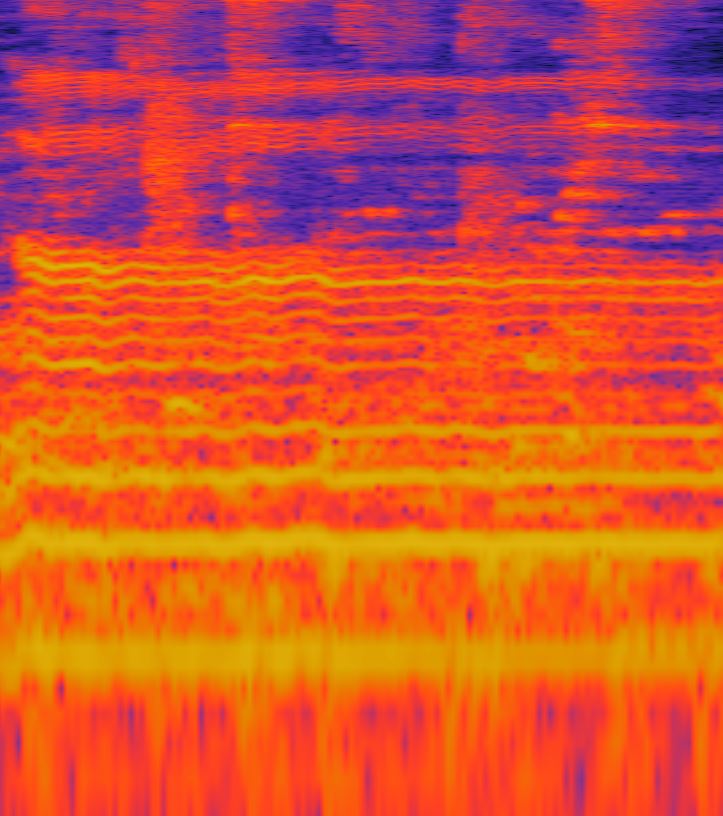
Last Thursday, I led a session at the Ragged University on Objects, Perception and Communication (see https://www.raggeduniversity.co.uk/2017/11/08/16th-nov-2017-objects-perception-and-communication-by-mark-johnson/). It was, in many ways, the same idea as the conference. I asked people to take a photograph of something in the room which revealed something about themselves. We sat in a circle and presented our photographs to each other. Then I illustrated the point about multiple description with music. Using a real-time spectrum analyzer, I showed how a single note is a patterned multiplicity of frequencies like this:

I think this patterned multiplicity is what occurs in the communicating around objects. In illuminating the understanding of each individual, they create the conditions for a "resonant polyphony" of alternative descriptions. Quite simply, we get to know each other better. I followed the singing with Augusto Boal's human statue exercise - another example of objects where people are the objects. Multiplicity of description can be investigated in many ways - with many descriptions!

Now I'm planning something bigger with the Far Eastern Federal University in Russia (Vladivostok). We are developing a course in "Global Scientific Dialogue" drawing on the ideas of David Bohm. 300 students in the University will participate in it next year. This is a radical experiment - and weirdly, something that could possibly only happen on the other side of the planet where the pathologies of EU/US education are less marked. In the 60s, we went to California to do new cool things. Now I think it's 10 hours flying the other way... (actually, it's 13 to Vladivostok).

Why Bohm? Well, he knew about multiplicity of description. This is very powerful: